Guide · Updated August 2026

How to Write Replies That Turn Mentions Into Customerswithout sounding like an ad

Monitoring hands you a stranger asking, in public, for exactly the thing you sell. Everything after that is writing — and this is what separates the reply that gets thanked from the one that gets downvoted.

Updated 18 min readBy the ParseStream team
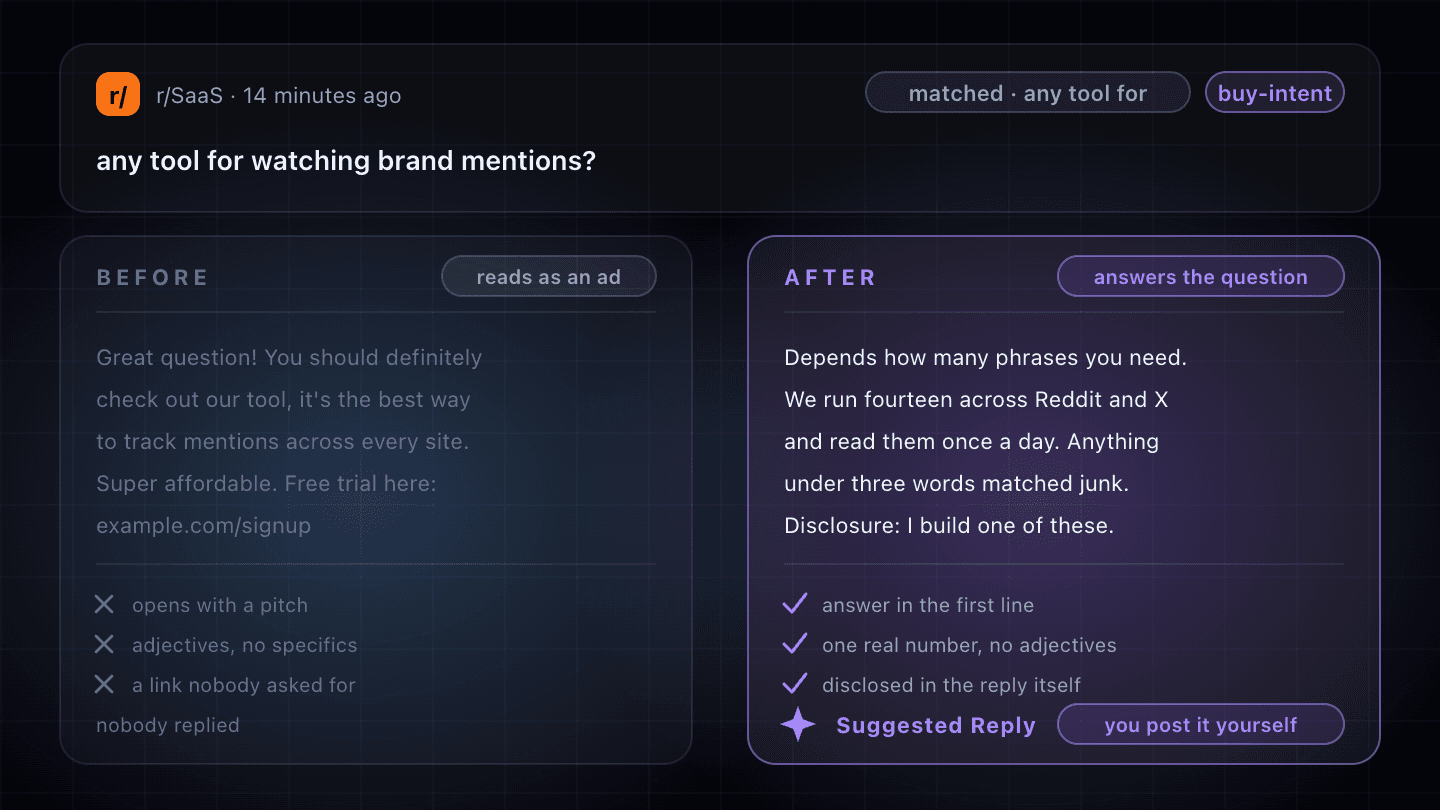
One r/SaaS post from fourteen minutes ago asking “any tool for watching brand mentions?” — matched to the keyword “any tool for” and tagged buy-intent — with the same reply written twice beneath it in two columns. The left column, headed BEFORE and marked “reads as an ad”, is greyed out and reads “Great question! You should definitely check out our tool, it's the best way to track mentions across every site. Super affordable. Free trial here: example.com/signup”, crossed off three times for opening with a pitch, using adjectives instead of specifics and dumping a link nobody asked for, and captioned “nobody replied”. The right column, headed AFTER in violet and marked “answers the question”, reads “Depends how many phrases you need. We run fourteen across Reddit and X and read them once a day. Anything under three words matched junk. Disclosure: I build one of these.”, ticked three times for leading with the answer, carrying one real number and disclosing inside the reply, and footed with “Suggested Reply” beside a button reading “you post it yourself”.
The short answer

How do you write a reply that turns a mention into a customer?

Lead with the actual answer to the question asked, in the first sentence, before naming your product at all. Replace every adjective with a specific — a number, a limit, a thing that does not work. Disclose that you build it, in the reply itself rather than in your profile. Then stop: no link unless somebody asks.

The test is to delete every mention of your company from the draft. If what remains still answers the question, post it. If it collapses into nothing, you have written an advertisement and it will be read as one. ParseStream drafts a Suggested Reply for each mention it finds across Reddit, X, LinkedIn, Quora and Hacker News; you edit it and post it yourself from your own account.

73%

of B2B decision-makers trust peer insights above vendor websites (55%), search engines (54%) and AI chatbots (39%) — a reply is the only one of those you can write.

Source: SurveyMonkey with Reddit
2 in 3

buyers now prefer engaging with vendor salespeople only in the later stages of their buying journey, up 17 percentage points in a year.

Source: G2 (2025 Buyer Behavior Report)
2 weeks

and a Hacker News thread closes to new comments for good — the only hard reply deadline any of these five platforms actually publishes.

Source: Hacker News FAQ
01

Why does the reply decide whether the mention was worth finding?

Monitoring is the solved half. You describe what your buyers say, something watches for it, and a queue of lead opportunities arrives — and none of that is worth anything on its own, because a found mention is a stranger's question you have not answered yet.

The answer is the deliverable, and it is the part nobody can do for you. A queue can be qualified, sorted and tagged automatically. The two hundred characters that go under someone's post are written by a person whose name is attached to them, in a room where everyone can see both.

The reply is the first sales conversation, and it is public

The old shape of this was a form, a routed lead and a call. G2's 2025 Buyer Behavior Report, surveying 1,169 B2B decision-makers, found that nearly two out of three buyers now prefer engaging with vendor salespeople only in the later stages of their buying journey — up 17 percentage points in a single year.

So first contact happens earlier, somewhere you do not control, and its format is a comment. That is not a downgrade. SurveyMonkey's study with Reddit found 73% of decision-makers trust peer insights above vendor websites, search engines, review sites and AI chatbots — and a reply is the only asset on that list you can write this afternoon.

The bar is a sceptical stranger's, not your marketing team's

Nothing you post is graded against your other marketing. It is graded against the comment above it, written by somebody with no stake in the answer, and against a reader's reliable instinct for being sold to.

Reddit's own guidance to its moderators is blunter than most marketing advice: “On Reddit, promotional content is not inherently considered to be spam.” The problem was never that you have something to sell. It is that most replies from people with something to sell are recognisably not answers to the question asked.

02

What does a reply that converts actually look like?

It looks like the answer somebody would have written if they had no product at all, plus one clause admitting that they do. The four moves below are how you get there under time pressure.

The order matters, because attention runs out roughly at the end of the first sentence.

  1. Step 1Put the answer in the first sentence

    Not a greeting, not “great question”, not context about who you are. The first clause should be usable by someone who reads nothing else — the recommendation, the number, the “no, that will not work because…”. Those first fifteen words decide whether you are worth listening to, and they are usually the only fifteen you get. The rule also enforces itself: it is very hard to lead with the answer and also lead with your product.

    • Good openings: “Depends how many keywords you need.” / “Two things bit us here.” / “Honestly, at that volume a spreadsheet is fine.”
    • Openings that cost you the reader: “Great question!”, “We built something for exactly this”, “Have you tried…” followed by your own product.
  2. Step 2Trade every adjective for a specific

    “Powerful”, “seamless”, “affordable” and “easy to use” are landing-page vocabulary, and a reader who has seen one landing page has seen them all. Specifics are the only credible signal available to a stranger: a number, a limit, a version, a thing that broke. The most persuasive one is usually unflattering — saying where your tool is the wrong choice buys more trust than any feature list, because nobody advertising to you would say it.

    • Replace “affordable” with the actual price, and “fast” with the actual interval.
    • Name one real constraint: a rate limit, a platform that only covers posts, a plan the feature is not on.
    • If a competitor fits their case better, say which and why. It costs one lead and buys the thread's trust.
  3. Step 3Disclose in the reply, not in your profile

    Half a sentence — “disclosure, I build one of these” — turns a suspicious reader into a neutral one, and it has to be in the comment itself. The US FTC's endorsement guidance addresses the profile-page defence directly: “Listing your employer on your profile page isn't enough. After all, people who just read what you post won't get that information.”

    The standard behind it is lower than most people assume: “if there's a connection between an endorser and the marketer that a significant minority of consumers wouldn't expect and it would affect how they evaluate the endorsement, that connection should be disclosed clearly and conspicuously.” A significant minority, not a majority — so if a reader would feel mildly annoyed to find out later, disclose now.

    Quora writes it down as policy and settles how much room it deserves: the disclosure “can be brief and does not need to be set off separately, as long as it is clear.”

  4. Step 4Stop before the pitch, and skip the link

    The reply ends when the question is answered. A bare URL as the whole comment is the fastest way to get reported anywhere, and even a well-placed one shifts the genre from answer to advertisement. Leave it out and let people ask — they do, and a requested link carries none of the resistance an unsolicited one does.

    Do not move the conversation into DMs uninvited either. X's own policy lists “sending bulk, aggressive, high-volume unsolicited replies, mentions, or direct messages” under what is not allowed, and every other platform treats it the same way informally.

03

How fast do you have to reply?

Fast enough to be in the conversation while it is still a conversation, which means something different on every platform: a reply that is three hours late on X is early on Quora.

Only one of the five publishes a hard clock: Hacker News states that threads are closed to new comments after two weeks, or sooner if the submission is killed by software, moderators or flags. Everything else below is observed behaviour rather than a platform rule.

Roughly how long a reply stays useful on each platform, and what that means for triage.
PlatformHow long the window stays openWhat that means for your reply
XHours. A post collects its useful replies while it is still circulating, and is finished by the next day.Same-day or not at all. Two lines, answer first: nobody scrolls back.
RedditA day for the conversation, years for the page — threads stop being read long before they stop ranking.Within the day if you want the poster; at all if you want the hundred who arrive from Google later.
Hacker NewsTwo weeks exactly, then the thread closes to new comments — the platform's own rule.Day one moves fastest, but a considered comment on day three still gets read. Never a rushed one.
LinkedInDays. A post resurfaces as it collects engagement, so the window is wider and less predictable.Same-day is ideal, next-day is fine. Being late costs little; being sloppy costs your professional identity.
QuoraEffectively none. A question is a permanent page that keeps collecting answers and readers for years.Write the best answer, not the fastest. The one place where taking an hour over it is simply correct.
Roughly how long a reply stays useful on each platform, and what that means for triage. Only the Hacker News figure is a published platform rule. The rest is how these threads behave in practice, and will not hold for every post.

Early and useful beats first and thin

Speed is a tiebreaker, not the goal. The reply that wins a thread is almost always the most useful one that arrived while the thread was live, and being first with something thin spends the only attention that post was ever going to give you.

So triage rather than sprint. Open the mentions where someone is asking a question you can answer today and let the rest wait for an afternoon when you can write properly. Intent tags make that take seconds instead of an hour: buy intent and product question have a clock on them, a pain point usually does not.

04

Before and after: the same reply, rewritten

Four mentions, each with the reply most people would send and the one that actually gets answered. The salesy versions are not straw men — they are the shape a draft takes when you write it thinking about your product instead of the question.

Reddit: “any tool for watching brand mentions without a VA?”

Before: “Great question! You should definitely check out our tool — it's the best way to track mentions across every platform. Super affordable, AI-powered, and there's a free trial: example.com/signup”

After: “Depends how many phrases you need to watch. We run about fourteen across Reddit and X and read them once a day, which is maybe ten minutes. The thing that actually matters is keyword length — anything under three words matched so much junk we cut it. Disclosure: I build one of these, so take the recommendation with salt, but the keyword advice holds whatever you use.”

What changed: the answer arrives first, the numbers are real, the disclosure is one clause inside a normal sentence, there is no link, and the advice holds whichever tool the reader picks — which is what makes the disclosure land as honesty rather than as a caveat.

X: “what's everyone using to monitor mentions these days?”

Before: “Hey! We've helped 100+ founders with exactly this. DMing you some info 🙌”

After: “If it's only Reddit, one of the free alert tools will do it. Past two or three platforms you want something that qualifies the matches or you drown in your own keywords. (biased — I build one)”

What changed: it fits the format, points at the cheaper option for the case where the cheaper option is right, and discloses in three bracketed words. The DM promise is gone — X's policy names unsolicited direct messages specifically, and a reply is read by the whole thread.

Hacker News: “how do you handle rate limits when polling these APIs?”

Before: “We solved this problem with our platform — it handles all the rate limiting for you so you can focus on your business. Happy to give you a demo!”

After: “One request a minute per source, with results cached for the interval, has held for us. The part that bit us was retries: a naive backoff turned one 429 into a thundering herd because every worker retried on the same schedule, so we jittered it. Full disclosure, this is from building a monitoring product, not a side project.”

What changed: it answers the technical question technically and volunteers the mistake. Hacker News's guidelines ask for comments that “get more thoughtful and substantive, not less” — the currency is having done the thing, and a demo offer reads as having nothing to add.

LinkedIn: “we're drowning in inbound and missing the good leads”

Before: “Couldn't agree more, Sarah! This is exactly why we built our platform. Would love to connect and show you how we're helping teams like yours 🚀”

After: “The fix for us was unglamorous: we stopped trying to read everything and picked two signals to route on — someone asking for a recommendation, and someone complaining about a competitor. Everything else went to a weekly digest nobody has to act on. Took a fortnight to tune and cut the queue by roughly two thirds. (I work on a monitoring tool, so this is my day job.)”

What changed: a specific operational answer with a real number and timescale, in the register LinkedIn asks for — its Professional Community Policies say plainly, “We allow broad conversations about the world of work, but just keep it professional.” The agreement-plus-pitch opening is the most recognisable move on the platform, and invisible for that reason.

05

When should you not reply at all?

Most of the discipline in this channel is in the mentions you skip. A queue of qualified lead opportunities creates a quiet obligation to act on all of them, and the wrong ones are how an account acquires a reputation it cannot spend its way out of.

Reddit's spam guidance frames the whole thing in one line: “Post authentic content into communities where you have a personal interest.” If you would not be reading the thread without the alert, that is worth noticing before you type.

  • The question is already answered well. Adding your product under a good answer is a pitch in a reply's clothes.
  • Your product does not actually fit. The temptation is a hedge — “we do something similar” — and it costs more credibility than the lead is worth.
  • It is a complaint about a competitor. Piling on reflects on you, not them — reply only if the person asks what else exists.
  • The thread is about something else. Your keyword matched a joke, a tangent, or a sentence that happens to contain your category term.
  • The room bans it outright. Some subreddits and Spaces disallow vendor participation entirely, and no amount of usefulness overrides a community rule.
  • You cannot write it properly right now. A rushed reply spends the mention permanently. On Quora and Hacker News in particular, later and better is strictly better.
  • You have already replied twice in that community this week. Nothing enforces a number, but a profile that is only your own product is the pattern every moderator looks for.
06

How does the right tone change per platform?

The structure from the anatomy section holds everywhere — answer, specific, disclosure, stop. What changes is register, length and how much of yourself the room expects to see. The same paragraph posted in five places reads as five different levels of effort.

Reddit: assume you are being audited

Readers here click usernames, so the profile is part of the reply: a good comment from an account with nothing but product mentions is worse than no comment. Lower-case conversational prose, admitted uncertainty, disclosure up front rather than in an edit. The room is not hostile to vendors — Reddit's own moderator guidance says promotional content is not inherently spam — it is hostile to vendors who only show up to sell.

Hacker News: the room grades your reasoning

The site's guidelines are unusually explicit: “Be kind. Don't be snarky. Converse curiously; don't cross-examine.” They ask you to “respond to the strongest plausible interpretation of what someone says”, and warn that “a good critical comment teaches us something.” Practically: no marketing register at all, technical detail welcome at any depth, and “we solved that” without saying how is worse than silence.

X: two lines, and the second one is optional

Brevity is not a style choice here, it is the format. Write a friendly opening and you have spent the reader's attention, so the answer is the first clause and the disclosure a parenthetical. Public replies also beat DMs on every axis, and X's policy names unsolicited direct messages specifically.

LinkedIn: professional, and permanently attached to your name

LinkedIn's Professional Community Policies ask that you “keep it professional”, and the audience is your actual industry rather than an anonymous crowd: complete sentences, a named role, no emoji-led enthusiasm. The failure mode here is the opposite of Reddit's — not too salesy but too agreeable to be worth reading, “great post, couldn't agree more” with a pitch attached. Say something a colleague could disagree with, or say nothing.

Quora: write the answer, not the reply

A Quora answer is a page rather than a comment, so it deserves structure, length and a headline sentence someone can quote. It is also the one platform that writes the disclosure rule down: your affiliation goes in the answer or the credential. Because the page keeps collecting readers for years, effort compounds here as it does nowhere else on this list.

07

Where do ParseStream's Suggested Replies fit?

Everything above works with no tool at all, and the writing is the part you should never hand over. What a tool removes is the two jobs around it: finding the mention while the thread is live, and getting a draft onto the page so you are editing rather than starting.

ParseStream watches your keywords across Reddit, X, LinkedIn, Quora and Hacker News, qualifies each match with your AI Filter and Lead Detection, tags what the person actually wants, and drafts a reply for the ones worth answering.

The draft is a first draft, and you post it yourself

Each Suggested Reply is written from your brand context and the mention it appeared under, then lands in Replies → Drafts with the original post one click away. Edit it in place, ask for an adjustment in plain English, regenerate it, copy it, or discard it — earlier versions stay available, so a worse rewrite is never destructive.

ParseStream does not post anything. Automatic posting is disabled at the server level on purpose, not for want of building it: an unedited AI reply is recognisable, and the argument of this whole page is that a comment published under your name should be one you have read. You copy the text, open the thread, and post it from your own account.

One tone per platform, set once

The register problem from the section above is a settings problem. Reply generation takes an approach — Value First, Case Study, User Testimonial or Maker Story — plus a length, whether your brand is referenced by name or by website, and custom instructions.

Each of those can be set per platform rather than globally, so Hacker News drafts arrive long and technical while X drafts arrive short and blunt, from the same brand profile. A platform-specific configuration wins over your default whenever one exists.

What it costs, and what it is worth using on

A generated reply costs 5 credits, against 1 for an approved mention and 1 more for an AI Filter. That gap is a deliberate nudge: the mentions worth 5 credits sit in the Leads view — approved mentions tagged buy intent or a product question. Use the draft to beat the blank page, then do the work this page is about: cut it to the answer, put a real number in it, keep the disclosure, delete the link.

Frequently Asked Questions

Does ParseStream post replies for me?

Won't people notice a reply was written by AI?

How quickly do I need to reply after a mention comes in?

Do I have to disclose that I work for the company?

Should I include a link to my product in the reply?

Can I set a different reply style for each platform?

Related reading

Where the mentions come from in the first place, and the platform rules that decide how a reply lands.

Get the mention while the thread is still open

ParseStream watches your keywords across Reddit, X, LinkedIn, Quora and Hacker News, qualifies the lead opportunities, tags what each person wants, and drafts a reply for you to edit and post yourself.

3-day free trial · Five platforms on one keyword list · You post every reply yourself