Guide · Updated August 2026

From Reddit Mention to Paying Customerwhat happens after the reply

You found the thread, you wrote something useful, you posted it. Everything from there runs on somebody else's timetable, out of your sight — and this is the part almost nobody writes down.

Updated 18 min readBy the ParseStream team
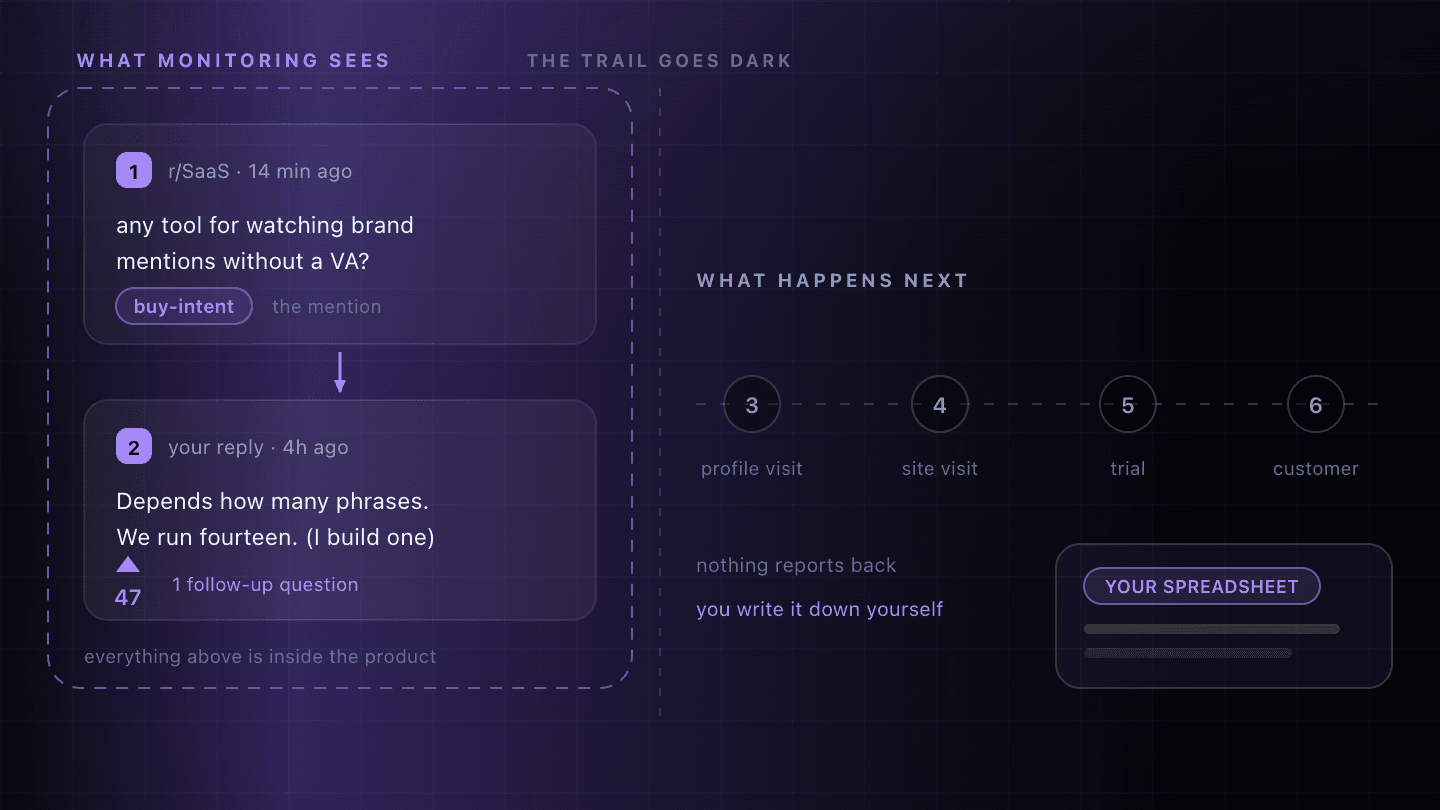
A dashed violet enclosure labelled “WHAT MONITORING SEES” holding two cards. The first, numbered 1 and marked “r/SaaS · 14 min ago”, reads “any tool for watching brand mentions without a VA?” and is tagged buy-intent beside the caption “the mention”. An arrow leads down to the second, numbered 2 and marked “your reply · 4h ago”, reading “Depends how many phrases. We run fourteen. (I build one)”, with 47 upvotes and the note “1 follow-up question”, over the line “everything above is inside the product”. A dashed vertical line labelled “THE TRAIL GOES DARK” runs down the middle of the canvas, and past it the artwork is a dashed track headed “WHAT HAPPENS NEXT” carrying four hollow numbered rings — 3 profile visit, 4 site visit, 5 trial, 6 customer — under the lines “nothing reports back” and “you write it down yourself”. A small raised card at the bottom right, headed “YOUR SPREADSHEET”, holds two ruled rows.
The short answer

What happens after you reply to a Reddit mention?

The thread does the qualifying. A useful reply collects upvotes; a good one collects a follow-up question; the best ones end with somebody else asking what you use. None of that is a transaction and none of it should be turned into one — keep answering until a link is genuinely asked for, then name the thing once and stop.

After that the trail goes dark. The profile click, the site visit and the signup weeks later carry no thread with them, so nothing tells you which comment produced which customer. The fix is unglamorous: log the thread URL, community and keyword the day you post, ask new signups where they heard about you, and read the two lists together monthly.

2 in 3

buyers now prefer engaging with vendor salespeople only in the later stages of their buying journey, up 17 percentage points in a year — which is why the reply is not the place to close.

Source: G2 (2025 Buyer Behavior Report)
1 request

is all an unsolicited Reddit chat gets: everything after it is suppressed until the recipient accepts, and suspected spam goes to a separate folder.

Source: Reddit Help
6 months

and a thread stops taking votes and comments for good — in any community whose moderators switched the archiving toggle on.

Source: Reddit Help
01

What does a good outcome from a public reply look like?

Not a sale. A reply is a piece of writing you published in somebody else's room, and everything that can happen next is small: a few votes, a question, a username click you will never see. Reading those correctly is most of the skill — the alternative is to treat a thread like a form submission and get discouraged inside a week.

The table below is what the visible signals actually mean. None of it is a Reddit rule — it is how these threads behave, and it will not hold for every post. Note where the most common outcome sits: most good replies get nothing at all, because the person who asked found their answer and closed the tab. The mistake that produces is real — a founder posts six careful replies, sees six quiet threads and goes back to cold email — and week one is far too early to have an opinion, because the returns on a public answer are back-loaded and mostly invisible.

The signals a public reply can produce, what each one really tells you, and the correct next move.
What you seeWhat it meansWhat to do
Upvotes, no replyThe room found it useful. The person who asked may not have come back to the tab yet.Nothing. It is now the answer everyone who searches this later reads first.
A follow-up question from the person who askedThe strongest signal available in a thread: they are still thinking about it, and asking you.Answer as carefully as the first time. This is where a link stops being an intrusion.
Somebody else asks what you useA third party has qualified you in public, which beats anything you could say about yourself.Answer, name it once in plain text, and stop. Do not add a pitch to a request.
A downvote, or a reply calling it an adYou wrote a pitch. Not fatal, and not worth arguing about — the room is telling you what it read.Leave it up, do not reply to the accusation, write the next one shorter and more specific.
SilenceThe most common outcome by a distance, and usually not a failure: the thread had its answer.Nothing. Do not comment again to bump it, and do not message the person.
The signals a public reply can produce, what each one really tells you, and the correct next move. Observed thread behaviour, not published Reddit policy. The only hard mechanic here is the archiving one further down the page.

The person who asked is one reader out of many

A comment does not stop working when the conversation stops. It stays in the community, it stays in search, and it keeps answering the same question for whoever arrives next — Reddit says as much in its own profile documentation: hiding a community's content from your profile leaves those posts and comments “still available in the original community where they were made, as well as in search results both on and off the platform.”

That is the actual argument for answering in public rather than privately, and it is worth holding on to when a thread goes quiet. One person asked. An unknown number of people with the same problem will read the answer, and every one of them is reading a recommendation that was not addressed to them, which is exactly the shape of thing buyers trust most.

02

When should you move to a DM, and when does that kill it?

The pull toward a private channel is strong and worth naming: a thread feels public and slow, a message feels direct and closeable. Sometimes it genuinely is the right move. Most of the time, on Reddit, it is the move that ends the conversation and costs you the thread. Both halves of that are true, so here is each of them plainly.

What a public answer does that a message cannot

A reply is read by the person who asked, by everyone else in the thread, and by everyone who lands on it from a search engine for as long as the page exists. A message is read by one person. Move a genuinely useful answer out of a thread and you delete it for everyone else, for nothing.

It also changes what the answer is worth to the one person who does read it. In public you are answering where anyone can contradict you; in private you are pitching, and both of you know it. The credibility came from the setting.

What Reddit actually does with an unsolicited chat

This is not a matter of etiquette on Reddit — the platform is built to absorb it. Reddit's own help centre describes the design: “For every new redditor who tries to message you in chat, you'll receive a single message request. All other messages will be suppressed until you accept the chat request. Requests that we detect as potential spam will be sent to a separate Additional requests section within your Requests.”

Recipients can narrow the door further, “allowing requests from everyone, only from accounts older than 30 days, specific people, or from nobody at all”. So a cold chat is one request, sitting in a folder that exists because of people doing exactly what you are considering. Note that this is chat and not the old private messages, which Reddit has retired: existing PMs are now “archived as read-only” and “cannot be replied to”.

None of that is Reddit blocking vendors, and it is not a rule you would be breaking. It is a measure of how much weight an uninvited message can carry: very little, and less than the comment you could have written instead.

If they open the door, walk through it

The whole calculation inverts when the other person moves first. Someone who replies “can I DM you about this?”, sends a chat request, or asks for your email has given you permission no amount of good writing in a thread can manufacture, and treating that cautiously is its own kind of rude. Answer, and answer properly.

The etiquette from there is short. Match their register and their length — a two-line question gets a two-line answer, not a deck. Answer the thing they asked before offering anything adjacent. If the answer would help the thread too, post a shortened version there as well, because the original question is still sitting unanswered for everyone else.

And keep the boundary where they drew it. An invitation to answer a question is not an invitation to a sales sequence, a calendar link or a mailing list.

03

How do you get from a thread to a trial without being pushy?

By never treating the link as a close. A link in this channel is a reference — where the specific thing you just described is written down at greater length — and it works in the position a reference occupies in normal conversation. It fails when it arrives as the punchline the whole comment was building toward, which readers detect immediately and accurately. The three moves below are the whole sequence.

  1. Step 1Answer until somebody asks

    The first reply carries no link at all. That is the rule the sibling guide argues for at length and it holds here: an unrequested URL changes the genre of the comment from an answer that mentions a product to an advertisement that answers something. What you want is the second exchange — the follow-up question, or the third party asking what you use — because a requested link arrives with none of the resistance an offered one carries.

    This is slower than pitching and it is the reason the channel works at all. G2's 2025 Buyer Behavior Report found that nearly two out of three buyers now prefer engaging with vendor salespeople only in the later stages of their buying journey, up 17 percentage points in a single year. A thread is not a later stage.

  2. Step 2Link the page that answers the question, and name what it misses

    When the link is asked for, send the thing that continues the sentence you were already writing: the rate-limit question gets the rate-limit documentation, the price question gets the pricing page. A homepage answers a question nobody in the thread asked and makes the reader hunt for the thing you were just talking about.

    Then scope it in the same sentence. “Here's the page — worth knowing it only covers posts on LinkedIn, not comments” costs you nothing you were going to get anyway and turns the link from a claim into information. It is also the cheapest defence against the thread turning on you later, because nobody can accuse you of overselling a thing you scoped yourself, in public, with the link.

  3. Step 3Then stop, and let them arrive on their own clock

    No urgency, no discount code, no “happy to jump on a quick call”. The link is out; the next move belongs to them and it will happen on a day you never find out about, from a device you cannot see, possibly weeks later. The temptation is to build a bridge — a follow-up comment, a message, a nudge — and every one of those turns a person leaning toward you into a person being sold to, which is the one transition this channel cannot survive.

04

What do you do when a prospect goes quiet?

In public, very little. Anywhere else, nothing. This is the hardest instruction on the page, because every other sales channel is built around the follow-up and this one punishes it.

The reason is structural rather than moral. In email a second message continues a conversation somebody opened by giving you an address; in a thread you replied to a stranger who never contacted you, so a second approach is a first approach with extra context. Reddit's spam policy sets the standard for the whole channel in one line: “Post authentic content into communities where you have a personal interest.”

  • Do not chase into chat. Everything in the section above still applies, and it applies harder once they have already read you and not replied.
  • Do not comment again to bump the thread, and do not edit the old comment to add a link that was not there. Both read as impatience to the one person who did not reply, and as noise to everyone else.
  • One more public comment is fine if something genuinely changed — the limitation you named got fixed, or a second person asked the same question. New information, not a new attempt.
  • Check the thread can even take a comment. A community whose moderators switched on the archiving toggle stops accepting votes and comments on posts older than six months, and you find that out by trying.
  • Then leave it. The comment keeps working in search whether or not that person returns, and the next mention is a fresh conversation with somebody who has not already declined this one.
05

What are the real stages between a mention and a customer?

Six of them, and you can see two. That ratio is the honest shape of this channel, and it is why community lead generation feels like guesswork even when it is working: the visible part is the beginning, and the beginning matters least to revenue. The table below is structural, and there are no rates in it on purpose.

Stage three is the one founders never think about and the one that quietly decides the rest. A reader weighing your answer clicks your username and finds either somebody who has been useful in this room for months, or an account whose entire history is its own product. Nothing about that is measurable, and it does not need to be — the fix is slow and known: have a history worth reading before you need one.

The stages a community lead moves through, and how much of each one you can actually observe.
StageWhat is happeningWhat you can see
1. The mentionSomebody writes the sentence your keyword matched, in a room you do not control.All of it — post, community, phrasing, timestamp.
2. Your replyYou answer in public, under your own name, where anyone can read it.All of it, plus votes and replies. The only step you fully control.
3. The profile visitThey click your username and read what else you have written. On Reddit this is close to reflex.Nothing at all. You will never know it happened.
4. The site visitThey open the link, or remember the name and search for it three days later.A visit in your analytics with no thread attached, and often no referrer.
5. The trial or signupThey start on their own schedule, often from a different device to the one that read the thread.A signup you cannot attribute, unless you asked on the form.
6. The customerThey convert weeks or months after the comment that started it, having never mentioned it.Revenue with no source. The only link back is the note you wrote yourself.
The stages a community lead moves through, and how much of each one you can actually observe. No conversion rates appear in this table on purpose. Every figure in circulation for community-sourced pipeline traces back to a single vendor's own funnel, and yours will not resemble it. Measure your own and treat the first three months as calibration.
06

Why do community leads close slowly — and then stay?

Because you removed the mechanisms that make other channels fast, and those are the same ones that make other channels churn. There is no deadline in a thread, no scarcity, no quota watching the deal, and nothing you can do to compress the timeline. What you get in exchange is a buyer who did the evaluation before you knew their name.

We are not going to attach a retention number to that. We do not have one that would survive being footnoted, and neither does anyone else quoting one at you. The argument rests on the two things below plus one absence: a customer who read your constraints in public, where anybody could have contradicted you, has expectations that already match the product, so there is no gap to discover in month two. That is the honest version of “community leads stick” — not loyalty, just the missing mismatch other channels manufacture on purpose.

They arrive pre-educated, because they did the reading

SurveyMonkey's study with Reddit found that 23% of US business decision-makers have used Reddit to research a business purchase, rising to a third — 32% — of software buyers. They are not browsing: reviews and testimonials are the top reason at 77%, but 45% are looking for pricing, 42% for capabilities and 36% for compatibility or integrations. That is the qualification call, conducted without you.

SurveyMonkey's own chief communications officer put the sequence plainly on that page: “When we're looking for new tools and technology, we ask around, read the reviews, search for competitors, and do our homework long before we ask to talk to sales.” A lead arriving from a thread has finished several steps you would otherwise pay to run, which is why the conversation you eventually have is short and unusually well-informed.

They selected themselves, and nobody was sold to

Nothing was sent to this person. They read an answer, clicked a name, read a history, opened a page and came back later — five decisions, all theirs, any of which they could have declined at no cost. A lead assembled out of five voluntary steps is a different object from one assembled out of a form fill and a follow-up sequence.

That same study found 73% of decision-makers trust peer insights above vendor websites (55%), search engines (54%) and AI chatbots (39%). A helpful comment in a thread is the only one of those you can write yourself — and it is read as the trusted category rather than the advertised one, which is precisely why the trust survives contact with your actual product.

07

How do you track which threads actually turn into customers?

By writing it down yourself, on the day, because nothing else will. Four of the six stages above emit no signal you can collect, and no monitoring tool — this one included — can see past the comment box. Any product claiming to attribute revenue to a Reddit thread is inferring, and you should ask how. What works instead is boring and takes about ninety seconds per reply.

The spreadsheet is the tool

One row per reply, filled in when you post: date, thread URL, community, the keyword that matched, the intent tag, one line on what you said, an empty outcome column, and a second date for when you last looked.

Once a month, open the threads and fill in the outcome column with whatever is observable — replies, a request for the link, nothing. Read the sheet by community and by keyword rather than by row, and the pattern arrives faster than you expect: one or two rooms produce conversations while the rest produce upvotes, and one keyword family produces questions while another produces people venting.

Ask on the signup form, because it is the only attribution you get

“How did you hear about us?” as an optional free-text field is unfashionable, imprecise, and the single most valuable measurement in this channel — the one moment where a person who has been invisible for four stages tells you which room they came from. It will not name the thread; it will say “Reddit”, or occasionally the community. Cross it against the sheet, and if signups keep naming a community you only replied in twice, that is where the next ten replies go.

What ParseStream can tell you, and what it cannot

It owns the front of the funnel, which is where the sibling guides leave you: keywords checked hourly across Reddit, X, LinkedIn, Quora and Hacker News, the AI Filter and Lead Detection qualifying each match, the Leads view collecting approved mentions tagged buy intent or a product question, and a Suggested Reply arriving as a draft for you to edit and post yourself from your own account. Catching the thread while it is live is the part a tool genuinely does better than a person.

There is one analytics surface, and its real scope is narrow. The dashboard's keyword performance widget shows, per keyword over the last 30 days, how many mentions were found and how many your AI Filter approved or rejected, as an approval rate. That measures how well a keyword is aimed. It says nothing about whether those conversations became customers.

Which is the honest limit: ParseStream does not track post-reply outcomes. You can mark a draft as Replied, which records that you posted it, and that is where the product's knowledge of the lead ends. No profile visit, no site visit, no trial, no sale — none of it is visible to a tool watching public threads, and the spreadsheet above is doing that job because there is nothing else to do it.

Frequently Asked Questions

How long does it take a Reddit lead to become a customer?

Should I DM someone who replied to my comment?

Can I include a link to my product?

Nobody replied to my comment. Did I do something wrong?

Does ParseStream track whether a mention turned into a customer?

How do I know which subreddits and keywords are worth repeating?

Be in the thread while the thread is still alive

ParseStream checks your keywords hourly across Reddit, X, LinkedIn, Quora and Hacker News, qualifies the lead opportunities, tags what each person wants, and drafts a reply for you to edit and post yourself. What happens after that is the part this page is about.

3-day free trial · Five platforms on one keyword list · You post every reply yourself