Guide · Updated August 2026

How to Get Customers from Hacker Newswithout setting off its allergy to marketing

HN's own guidelines say “Please don't use HN primarily for promotion”, and the advice its Show HN page gives founders is to drop any language that sounds like marketing or sales. Both are true, and neither means you cannot sell anything there. This is how the site works, what a good Show HN looks like, which threads are actually worth your time, and how to comment as a founder without getting flagged.

Updated 18 min readBy the ParseStream team
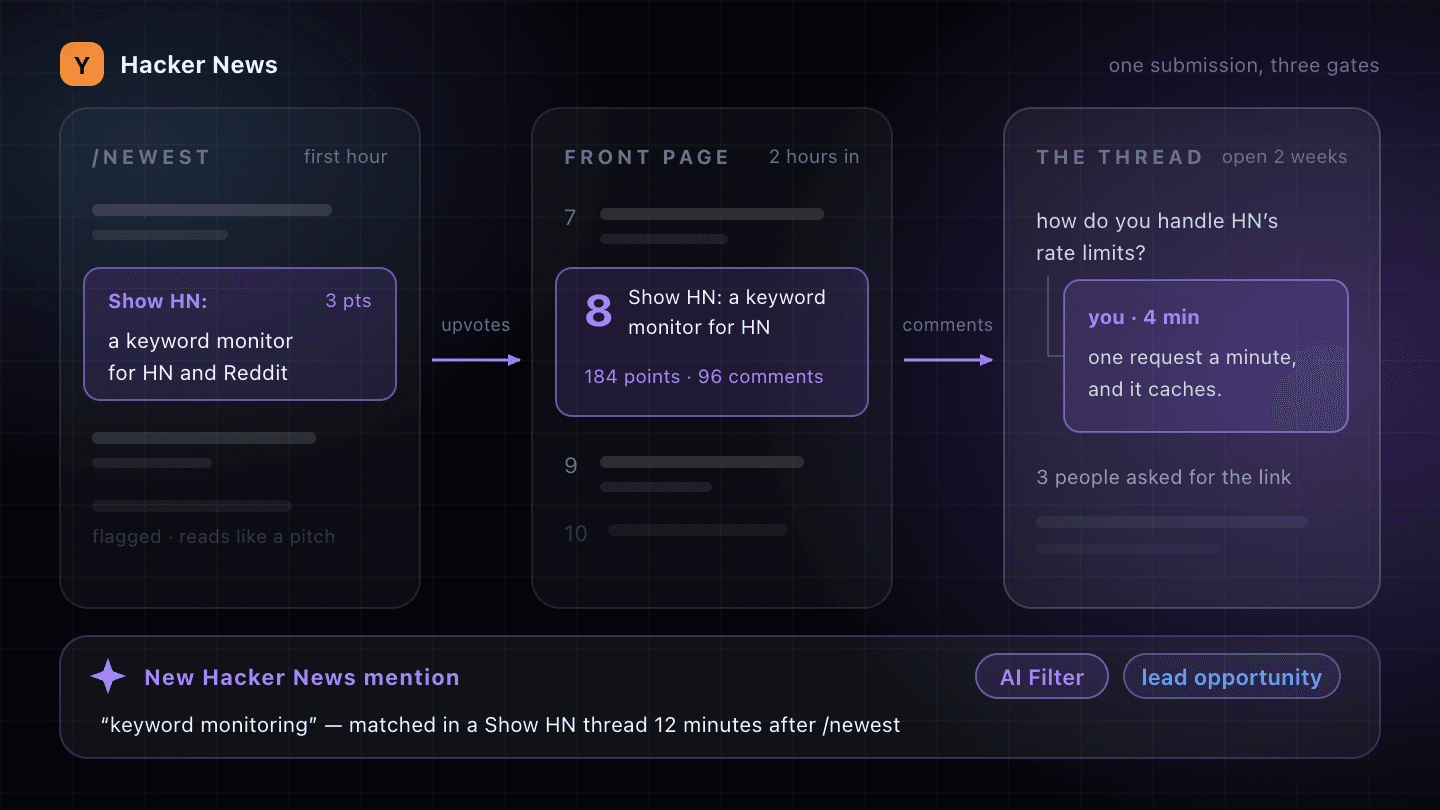
One Hacker News submission traced through three cards left to right. On “/newest · first hour”, a highlighted “Show HN: a keyword monitor for HN and Reddit” on 3 points sits above a dimmed entry captioned “flagged · reads like a pitch”. An arrow marked “upvotes” leads to “front page · 2 hours in”, where the same submission holds rank 8 with 184 points and 96 comments. An arrow marked “comments” leads to “the thread · open 2 weeks”, where a question asking how you handle Hacker News rate limits is answered by a nested reply marked “you · 4 min” reading “one request a minute, and it caches”, noted as “3 people asked for the link”. Along the bottom, a ParseStream alert reads “New Hacker News mention”, tagged AI Filter and lead opportunity, over the line “keyword monitoring — matched in a Show HN thread 12 minutes after /newest”.
The short answer

How do you get customers from Hacker News?

You get customers from Hacker News by being useful in threads where your problem space already came up, and — once, when the thing genuinely works — by posting it as a Show HN. HN's guidelines allow posting your own work: “It's ok to post your own stuff part of the time, but the primary use of the site should be for curiosity.” What the community punishes is the register, not the commercial interest. Factual, technical, first-person writing survives; anything that reads like a landing page gets flagged.

The practical constraint is timing. A Hacker News thread accepts new comments for two weeks and is usually decided in the first few hours, so the whole game is being present while the conversation is live. ParseStream monitors Hacker News stories and comments for the phrases that matter to you and surfaces those mentions as lead opportunities — on every plan, including the $29 entry tier.

2 weeks

is how long a Hacker News thread stays open to new comments before it closes for good — the page keeps ranking, but your chance to be in it does not.

Source: Hacker News FAQ
40%

of software buyers spend several weeks to a month or more researching before buying — most of it in places you were never invited to.

Source: SurveyMonkey with Reddit
73%

of B2B decision-makers trust peer insights above vendor websites (55%), search engines (54%) and AI chatbots (39%).

Source: SurveyMonkey with Reddit
01

How does Hacker News actually work?

Well enough to be worth ten minutes before you post anything — most first attempts fail for mechanical reasons rather than because the thing posted was bad. The site describes its own subject matter as “anything that gratifies one's intellectual curiosity”, and that is the standard the community applies: not is this good, but is this interesting to a curious technical stranger who has never heard of you.

The front page is a decay curve, not a leaderboard

HN's FAQ states the mechanic plainly: “The basic algorithm divides points by a power of the time since a story was submitted. Comments in threads are ranked the same way.” Points age out, so fifteen upvotes in the first hour beat forty over two days, and a submission either moves early or not at all.

Other things push it around — “user flags, anti-abuse software, software which demotes overheated discussions, account or site weighting, and moderator action”. One thing does not: asked whether high-karma users rank higher, the FAQ answers “No.” There is no reputation to bank that makes your next post travel further.

Everything starts on /newest, and most of it stays there

Every submission lands on the new page first, where a handful of people read it and decide its fate inside an hour. Show HN and Ask HN posts get their own new lists, “but there is a small points threshold before a post makes it to ask or show.” Accept the implication before you spend a week preparing a launch: most submissions get nothing, including good ones.

Flags are the real moderation, and they are fast

HN asks readers to flag: “If a story is spam or off-topic, flag it.” Enough flags and a post shows as [flagged] — “Users flagged the post as breaking the guidelines or otherwise not belonging on HN” — or [dead], “killed by software, user flags, or moderators.” No moderator has to notice you for a marketing-flavoured submission to vanish, which is the mechanism behind every story about HN being brutal: not a jury, just a few hundred people with a flag link.

Show HN and Ask HN are different products

  • Show HN is for things people can try. It has its own guidelines, and it is the only sanctioned way to post your own product.
  • Ask HN “lists questions and other text submissions” — including the “what do you use for X” threads that are the most convertible surface on the site.
  • A “Who Is Hiring?” thread appears on the first weekday of each month, and it is the only place job ads belong: “Please don't post job ads as submissions to HN.”
  • Reposts are allowed sparingly — “If a story has not had significant attention in the last year or so, a small number of reposts is ok.”
02

What makes a Show HN land?

Honesty about what the thing is, and a working link. The Show HN guidelines are short and unusually literal — “Show HN is for something you've made that other people can play with” — and the failures are nearly always people who wanted the audience without meeting the condition. Those guidelines also link to a page of tips for presenting your work; what follows leans on both.

  1. Step 1Check that you have a Show HN at all

    The off-topic list is explicit: “blog posts, sign-up pages, newsletters, lists, and other reading material. Those can't be tried out, so can't be Show HNs.” Nor does unfinished work qualify — “If your work isn't ready for users to try out, please don't do a Show HN. Once it's ready, come back and do it then. Don't post landing pages or fundraisers.” Two more filters: “The project should be non-trivial. Don't post quickly-generated one-offs”, and incremental releases are out — “New features and upgrades (“Foo 1.3.1 is out”) generally aren't substantive enough to be Show HNs.”

  2. Step 2Remove every barrier between the link and the thing working

    “Please make it easy for users to try your thing out, ideally without barriers such as signups or emails. You'll get more feedback that way.” This is the highest-leverage change most founders can make to a launch, and the one most resisted, because the signup wall is where the funnel starts.

    Put a demo, a sandbox, a public repo or a hosted example one click from the submission. If your product genuinely cannot work without an account, say so and give people something else — a video, a read-only instance, a write-up with screenshots.

  3. Step 3Write the text by hand, in the register HN uses

    The tips page is blunt: “Drop any language that sounds like marketing or sales. On HN, that is an instant turnoff. Use factual, direct language.” It is equally blunt about who writes it — a 2026 edit adds “Write your text by hand. Don't use an LLM to generate any of it (not even a tiny bit, including to edit or spruce it up)”, and the site guidelines say the same in one line: “Don't post generated text or AI-edited text. HN is for conversation between humans.”

    • “Include a clear statement of what your project is or does. If you don't, the discussion will consist of “I can't tell what this is”.”
    • “Include text giving the backstory of how you came to work on this, and explaining what's different about it. That tends to seed discussion in a good direction.”
    • Link any earlier HN threads on the same work — readers like those.
    • “Don't have your username be that of your company or project. It creates a feeling of using HN for promotion and of not really participating as a person.”
  4. Step 4Be in the thread all day, answering as yourself

    “The project must be something you've worked on personally and which you're around to discuss.” A Show HN where the founder answers every technical question for eight hours outperforms a better product whose author posted and left — the comments are the launch, and the submission is just the door.

    Answer the harsh ones first and answer them straight. “Why not just use X?” is the most common question on any Show HN, and a specific, unembarrassed answer — including where X is genuinely better — does more for you than all the surrounding praise.

  5. Step 5Do not touch the votes

    The Show HN guidelines say “Please don't ask friends to upvote or comment. That's not ok on HN”, the site guidelines say “Don't solicit upvotes, comments, or submissions”, and the FAQ is explicit about enforcement: “We penalize or ban submissions, accounts, and sites that break this rule, so please don't.” It also does not work — “HN readers are sensitive to this and will detect it, flag it, and use unkind words like ‘spam’.” A thin thread with four honest replies beats a padded one read as astroturf.

03

Which Hacker News threads actually produce customers?

Very few, and almost never the ones people chase. A Show HN is a single event you can run perhaps once or twice a year — the tips page says a repost of significantly changed work “should probably only happen once or twice a year—more starts to be excessive”. Everything else comes from comments in threads somebody else started. Three shapes are reliably worth your time.

The same judgement, applied to the threads you will actually be looking at.
The threadComment?Why
“Ask HN: What do you use to monitor mentions of your product?”Yes, immediatelyA direct request for recommendations from someone describing their own situation. Disclose, answer properly, and name the alternatives too.
A front-page postmortem about the problem your product solvesYesComment on the problem, not the product. If your tool belongs in the answer that will be obvious; if not, you still bought credibility for the next thread.
A competitor's Show HNCarefully, or not at allCongratulate or ask a real question. Never use someone's launch thread as a comparison ad — the fastest way to be remembered badly by exactly your audience.
A story that merely contains your keywordUsually noSubstring matches catch a lot of nothing. Presence of a word is not presence of a conversation you belong in.
A politically charged or already-heated threadNoHN demotes “overheated discussions” by its own account, and nothing you write there reads as anything but noise.
A thread older than two weeksCannotComments are closed. The page keeps ranking and keeps being read; you simply are not in it.
The same judgement, applied to the threads you will actually be looking at. When two threads look equally good, take the newer one. HN ranks by points divided by a power of elapsed time, so a comment posted in hour two is read by an order of magnitude more people than the same comment posted on day two.

“Ask HN: what do you use for X”

The closest thing HN has to a buying question: somebody has described their situation in detail and asked a technical audience what to use. Everyone answering is naming tools, so naming yours — with the disclosure and the honest limits — is exactly what the thread asked for. These keep converting long after they close, because they are the pages people find when they later search the same question.

Threads where your problem space comes up sideways

A postmortem about the failure mode you prevent, a story about the category, a heated thread about the thing everyone still does by hand. Nobody asked for a recommendation, which is the point: a comment substantively about the problem, with your product mentioned once and only where relevant, reads as a practitioner talking rather than a vendor arriving. Most of the sustained return lives here, and it is the least visible category from outside — which is why it is worth monitoring for.

Threads about a competitor

Someone announcing, complaining about, or comparing a tool in your category. You are the least credible voice there, and the only way to be worth reading is to be genuinely fair, including about where they are better. HN's comment guidelines set the bar: “Please don't post shallow dismissals, especially of other people's work. A good critical comment teaches us something.” A dismissive comment about a rival costs you more standing than the rival loses.

04

How do you comment as a founder without getting flagged?

By writing the comment you would have written if you had no product, and then adding one clause. That is very nearly the whole method, and it is why founders deep in a problem do well on HN while marketing teams do not. The guidelines read as a style guide rather than a rulebook — “Be kind. Don't be snarky. Converse curiously; don't cross-examine” — and none of it is about promotion, while all of it decides whether you are read.

Substance first, product last, once

Lead with the specific technical thing you know: the number, the constraint, the approach that failed, the reason the obvious solution breaks at scale. Mention what you build at the end, in one sentence, and only when it answers the question. A comment that is 90% substance and 10% product reads as expertise; the same content reversed reads as an ad and gets flagged. The site's own framing is that self-promotion is fine as a minority activity.

Disclose, even though HN does not make you

Worth stating precisely, because this is where secondhand advice goes wrong: Hacker News's guidelines contain no affiliation-disclosure rule, unlike Quora, which has an explicit one. What HN has instead is a community that flags undisclosed vendor comments.

Disclose anyway, in the comment itself. The US FTC's endorsement guidance — general advice, nothing to do with HN — makes the reason concrete: “Listing your employer on your profile page isn't enough. After all, people who just read what you post won't get that information.” Half a sentence removes the only reason anyone has to flag you.

One account, and it is yours

“Throwaway accounts are ok for sensitive information, but please don't create accounts routinely. HN is a community—users should have an identity that others can relate to.” A second account used to say nice things about your first is not a growth tactic here; it is the thing that ends the account. The corollary is that a real posting history is an asset, and the difference is visible on a profile page in four seconds.

Write it yourself

HN's guidelines are unambiguous: “Don't post generated text or AI-edited text. HN is for conversation between humans.” That is a real constraint on how any monitoring or reply tool can be used here, and pretending otherwise would not survive contact with the audience. The workable arrangement is that software finds the thread and you write the comment.

05

Why does a Hacker News thread keep working after the front page?

Because the thread does not go anywhere. Comments close after two weeks, but the page stays exactly where it was: a plain, static, un-paywalled URL with no login wall and no infinite scroll, which is close to the ideal shape for both a search crawler and a model that reads the web. The front-page spike is measured in hours; search traffic to the same thread is measured in years, and almost nobody plans for it.

The long tail belongs to the comment, not the story

The queries that find an old HN thread are rarely the story's title. They are the specific things said in the comments — the error message, the workaround, the “we tried X and moved to Y because” sentence somebody wrote at 2am. A comment that names a tool, states a limitation and gives a number is the one that gets found, which is the same discipline the live thread rewards. Write the specific version and the search benefit arrives as a by-product rather than a second job.

And AI answer engines read exactly these pages

Answer engines lean heavily on community discussion, because it is where practitioners compare real tools. Be careful with the evidence, though: the published citation-share measurements cover Reddit in detail, and nobody publishes a comparable figure for Hacker News. Borrowing Reddit's number and putting an HN label on it would be inventing a statistic.

What can be said honestly is structural. HN threads are text-dense, crawlable, permanently addressable and full of specific technical claims attributed to named accounts — the properties that make a passage quotable. So write so a single paragraph survives being lifted out of context: conclusion first, evidence in the same comment. The register HN demands is also the register that ranks and gets quoted, which is why the constraint everybody complains about is what makes the channel durable.

06

How do you catch the threads while they are still live?

By hand, at first. Search Hacker News for your problem in a customer's words, read a week of what comes back, and you will learn which phrases are worth tracking faster than any tool can tell you. It stops working for the usual reason: it depends on you remembering, every day, forever.

That is the argument for automating this on HN specifically. On an evergreen platform, being late costs a position. Here it costs the conversation — comments close after two weeks, and the interesting part closes far sooner.

  1. Step 1Add your brand before you add a single keyword

    The website, a short description of what you sell and who buys it, and the competitors you keep losing to. Every qualification step downstream reads from that description, so a vague one produces vague filtering.

    Hacker News keywords are on every ParseStream plan, including the $29 Lite tier, which carries 20 Hacker News keyword slots alongside 20 Reddit ones. Unlike Quora, LinkedIn and X, there is no upgrade to make first.

  2. Step 2Track the language of the threads, not your product name

    Your brand name catches the handful of people who already know you. The lead opportunities are in the words people use before they have heard of you — and on HN those words are unusually technical, which is an advantage, because specific phrases are quieter phrases.

    • Ask-phrases: “what do you use for”, “any recommendations for”, “how do you handle”, “anyone using”.
    • Problem phrases in a developer's words: “ended up writing a script”, “doing this manually”, “cron job that”, “spreadsheet for”.
    • Competitor names, plus the shapes that surround a switch: “migrating off”, “alternative to”, “vs”.
    • The category and its adjacent jargon — including terms your buyers use that your marketing site does not.
  3. Step 3Expect substring matches, and filter accordingly

    Keyword matching is case-insensitive and substring-based with no word boundaries, and Broad Match — the default — only requires every word to appear somewhere in the text, in any order. On a site full of technical vocabulary, a two-word keyword catches more than you expect.

    An AI Filter is the fix: a rule you write in plain English and attach to a keyword — “only keep threads where someone is asking for a tool recommendation or describing a problem we solve”. Lead Detection is the second pass, checking each mention against your brand context to decide whether it is a genuine lead opportunity or a thread that merely contains your words.

  4. Step 4Triage by intent, because the window is short

    Whenever Lead Detection or an AI Filter runs, ParseStream also tags what each mention is — buy intent, product question, competitor complaint, pain point, testimonial or promotional — at no extra credit cost. On Hacker News that tag is mostly a scheduling tool: it says which of this morning's mentions deserves the twenty minutes you have before the thread cools.

    ParseStream watches Hacker News stories and comments, and a newly added keyword runs immediately with a week of Hacker News history behind it, so you learn within minutes whether a phrase was worth tracking. After that, each keyword is re-checked about once an hour.

  5. Step 5Read the draft, then write the comment yourself

    ParseStream drafts a Suggested Reply from your brand context and the thread it appeared in. On Hacker News, treat that draft as orientation rather than copy — the guidelines ask you not to post generated or AI-edited text, and this audience detects it better than any other in the set.

    Nothing is posted on your behalf in any case: automatic posting is disabled at the server level by design, so every comment under your account is one you wrote and submitted yourself. Here that is not a limitation, it is the only usable arrangement.

Frequently Asked Questions

Is promoting your own product against Hacker News rules?

What qualifies as a Show HN?

Can I ask friends or teammates to upvote my Show HN?

Can I use AI to write my Hacker News comments?

Do I need a paid plan to monitor Hacker News keywords?

How long does a Hacker News thread stay worth replying to?

Be in the thread while it is still open

Add the phrases your buyers use when they are asking a technical audience what to use, and ParseStream surfaces the Hacker News stories and comments worth your time, tags what each person actually wants, and leaves the writing to you.

3-day free trial · 20 Hacker News keywords on Lite · You write and post every comment yourself