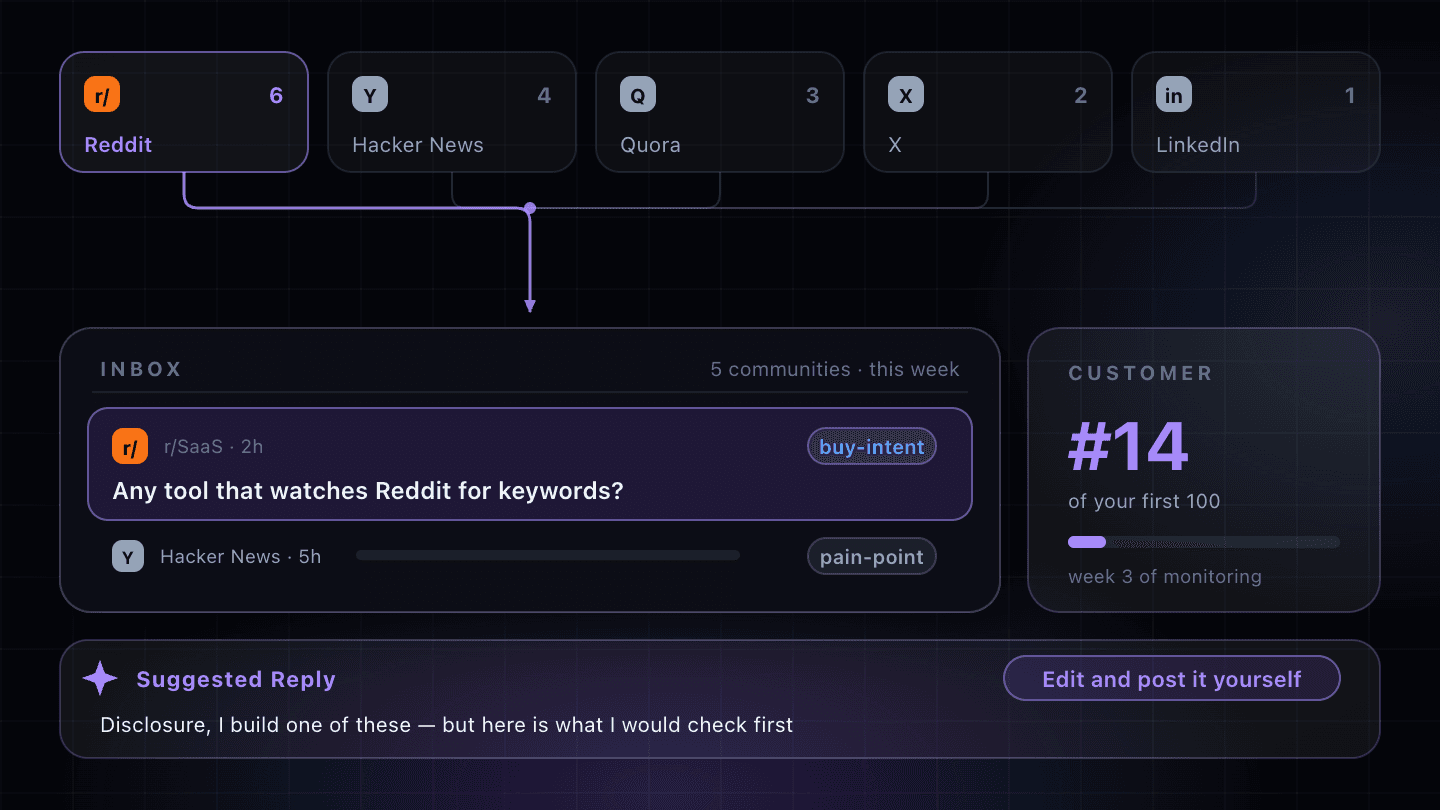
Why do the first 100 customers come from communities?
Because there is nowhere else for them to come from yet. You have no brand, no backlinks, no referrals and no budget that survives a paid experiment. What you do have is the ability to go where people are already discussing your problem and be conspicuously useful about it — a channel open to a company of one precisely because it does not scale.
The first users get recruited, not acquired
Paul Graham's essay on the subject remains the clearest statement of it. “The most common unscalable thing founders have to do at the start is to recruit users manually,” he wrote in 2013. “Nearly all startups have to. You can't wait for users to come to you. You have to go out and get them.” The line before it is the one that stings: “Actually startups take off because the founders make them take off.”
His best example is what Y Combinator calls the “Collison installation”. Where most founders would email a link and hope, Stripe's founders “weren't going to wait” — when anyone agreed to try it they would say “Right then, give me your laptop” and set them up on the spot. That is the register the first hundred are won in: not a funnel, but a hundred separate people deciding you were worth the risk because you were useful to them first.
Your buyers are already asking, in public, before they buy
This is not a hunch about how software gets bought. A study SurveyMonkey ran with Reddit among 1,202 US business decision-makers found 83% self-research before ever speaking to sales, and that peer recommendations are the most trusted channel they have: 73% trust peer insights, ahead of vendor websites (55%), search engines (54%), review sites (46%) and AI chatbots (39%).
G2's 2025 Buyer Behavior Report, from 1,169 B2B decision-makers, found nearly two out of three now prefer to engage a vendor's salespeople only in the later stages — up 17 percentage points in a year. So the part of the buying process you are allowed into happens in public, among peers, long before anyone fills in a form. There is also a standing supply of dissatisfaction: Forrester, surveying more than 16,000 global business buyers, found 81% express dissatisfaction with the provider they chose at the end of a purchase everyone would call successful.
What this is not
It is not a launch. A launch is one day with a spike and a long tail of nothing; this is a habit with a slope, and the two are easy to confuse until the spike is over.
It is not astroturfing, and the distinction is not subtle. One real account, disclosed affiliation, replies you would stand behind if the reader knew everything — that is participation. Multiple accounts, invented enthusiasm, friends brought in to upvote — that is what these communities are built to detect, and getting caught costs you the only place your buyers gather.
And it is not a substitute for the product being good: if the first ten people you help try it and quietly do not come back, the monitoring is doing its job.