Guide · Updated August 2026

How to Find Product Ideas and Pain Points on Redditcustomer research nobody was asked to give

People describe their unsolved problems in public, at length, in the exact words they would never use in a survey. This is how to read that: the sentence shapes that mark real pain, the tests that separate a signal from a bad day, and how their wording becomes your headline.

Updated 18 min readBy the ParseStream team
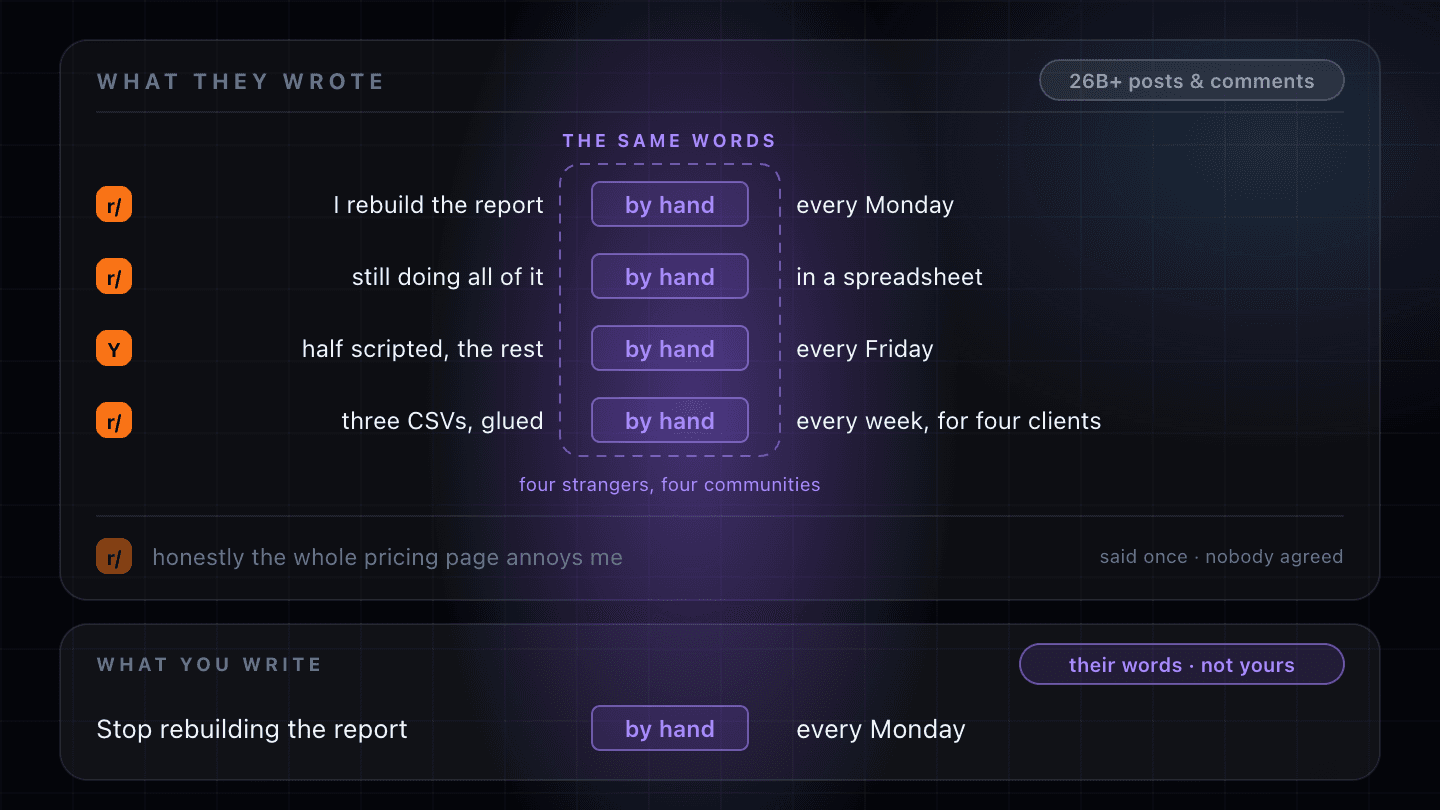
A panel headed “WHAT THEY WROTE”, beside a pill reading “26B+ posts & comments”, holding four quoted complaints of different lengths: “I rebuild the report by hand every Monday”, “still doing all of it by hand in a spreadsheet”, “half scripted, the rest by hand every Friday” and “three CSVs, glued by hand every week, for four clients”. Three carry a Reddit icon and one a Hacker News icon. The words “by hand” are highlighted in violet in every line and sit in one straight column marked by a dashed outline labelled “THE SAME WORDS”, captioned “four strangers, four communities”. Below a hairline, greyed out with nothing highlighted, a fifth line reads “honestly the whole pricing page annoys me” and is captioned “said once · nobody agreed”. A strip underneath, headed “WHAT YOU WRITE” beside a violet pill reading “their words · not yours”, carries the headline “Stop rebuilding the report by hand every Monday”, with “by hand” highlighted on the same vertical line as the column above it.
The short answer

How do you find pain points on Reddit?

Read the threads where people describe a problem they have not solved yet, then check whether the same description recurs. The language is recognisable: “how do you deal with…”, “is there a tool that…”, “why is it so hard to…”, “am I the only one who…”, and descriptions of a manual workaround somebody built for themselves. Search those as literal strings in the communities your buyers use, and read fifty threads before judging any one of them.

One complaint is a bad day. A pain point is the same complaint written by strangers who have never met, in different words, over months — with somebody in the replies describing what they built to survive it. That last part, usually a spreadsheet, is the strongest free signal there is: a person already paying, in their own hours, for something you could charge for.

43%

of VC-backed startups that shut down since 2023 cited poor product-market fit — the most-named root cause, behind only running out of capital.

Source: CB Insights
26B+

posts and comments on Reddit as of June 2026, most of them written to other users rather than to a company.

Source: Reddit, Inc.
83%

of B2B decision-makers complete their research via peer communities and self-directed search before ever engaging a sales team.

Source: SurveyMonkey with Reddit
01

Why do complaint threads beat surveys?

Because nobody asked. A survey question is a prompt, and a prompt is a hypothesis you wrote before you knew anything — so the respondent's job quietly becomes rating your idea instead of describing their week. A Reddit thread has no prompt: somebody was annoyed enough to type it out at eleven at night, for strangers who might well tell them they are doing it wrong.

That shows up as three properties you cannot buy — the complaint is unprompted, specific and public. Product-market fit is what failed in 43% of the VC-backed shutdowns CB Insights catalogued since 2023, behind only running out of capital, which it calls the final cause of death rather than the root problem. Reading complaint threads is not insurance against that. It is the cheapest way to find out early.

Unprompted means you learn what you did not ask about

Ask “would you pay for a tool that does X?” and you get a number, wrong in a direction you cannot see, because you supplied both the X and the frame. Read what people volunteer instead and the surprise arrives intact: the part that actually hurts is the third step, not the one you named. The corollary is uncomfortable — if every thread you find is about the feature you already planned, you have found your own search terms rather than a pain point.

Specific, because they are talking to peers

People describing a problem to a vendor round it off; they know they are being sold to. People describing it to peers name the tool, the day of the week, the number of rows, the colleague who breaks it. “Reporting is painful” is not actionable. “I export three CSVs every Monday, glue them together with VLOOKUP, and the client's ops guy still emails asking why the totals moved” is a product spec, a headline and an objection-handling paragraph in one sentence.

Public, dated, and already argued over

A survey response is one person's word in a spreadsheet you own. A thread is a durable artefact with a timestamp, a score and a row of replies saying “same” or “no, you're doing it wrong” — the claim and its peer review together, years after it was written. 83% of the B2B decision-makers SurveyMonkey surveyed with Reddit said they complete their research via peer communities and self-directed search before ever engaging a sales team. The instinct that keeps them away from your sales team keeps them candid in front of each other.

02

What does an unsolved problem sound like?

Pain has a small number of sentence shapes, and they are not the shapes of buying. Somebody ready to buy asks which product; somebody in pain asks whether anything exists at all, whether they are the only one, or describes the workaround they have already accepted.

Search these as literal strings rather than as topics. The point is not to find people discussing your category — most of them will never name it — but to find the sentence shape that means a problem has gone unsolved long enough to complain about.

Five language patterns that mark an unsolved problem, and what each one is worth.
PatternWhat it tells youWhat to do with it
“how do you deal with…” · “how do you all handle…”The problem is real and normalised. The writer assumes everybody has it and wants coping strategies, not products.Read every reply. Those answers are your real competitive set, and most are manual. (As a keyword the stem is catalogued in our social listening keywords guide; here it is the replies that matter.)
“is there a tool that…” · “does anything exist that…”It is felt hard enough to go looking, and the category has no obvious answer in this person's head yet.The closest thing to a free product brief. Write down the capability in their words.
“why is it so hard to…” · “how is this still a problem”Frustration with something that exists rather than an absence — usually a gap in a product they already pay for.Cross-reference against competitor threads: a feature gap with a vendor's name attached.
“what I ended up doing was…” · “we keep a spreadsheet…”Somebody is already paying for this in their own hours. The strongest signal on this page, by a distance.Copy the description verbatim. It is your onboarding flow and your before-and-after.
“am I the only one who…” · “tell me I'm not crazy”A problem the writer suspects is theirs alone. The replies settle it, so the frequency test runs itself.Judge it by the comments. Twenty “nope, same here” replies is a market; two is a preference.
Five language patterns that mark an unsolved problem, and what each one is worth. None of these contain your category, your brand or a competitor's name, which is why they reach people who have never heard of you — and why they rarely contain the word your marketing uses.

The workaround sentence is worth more than the complaint

One row is decisive. When somebody describes what they built to survive a problem — the spreadsheet with the colour-coded tab, the cron job, the Zapier chain held together by a Google Form — they tell you three things at once. The problem is worth real effort. Nothing off the shelf fits, or they would have bought it. And they have already sketched the solution's shape.

That is why the DIY spreadsheet is the classic pre-product signal: a spreadsheet is what a market builds when it has a job and no software. Five people who independently built the same one is a product; one is a hobbyist.

Where this stops and buyer intent starts

These are not buying signals, and treating them as such wastes both lists. A buyer intent phrase — “any tool for”, “X vs Y”, “alternative to X”, “moving away from X” — means the writer accepts that a category exists and is asking which product to give money to. The phrases here mean the opposite: a problem, no vocabulary, no shortlist, often no belief that software for it exists.

The difference is what you do next. Pre-purchase language is a reply opportunity today, with a window measured in hours; pre-product language is research, and its writer may not buy anything for a year. Track both, read them in separate sittings, and never judge a pain-point keyword by the customers it produced this week. Our guide to buyer intent keywords is the other half of the pair.

03

How do you tell a real problem from a bad day?

Reddit is also where people complain about things that are basically fine. Every category has a background hum of irritation no product will ever fix, and the failure mode of this research is mistaking hum for signal — usually because the first thread you read was well written and you were already hoping.

Test one: does it recur where you were not looking?

One thread is an anecdote. The test is not whether you can find more by searching harder — you always can — but whether the same description turns up in threads you did not go looking for, in communities that have nothing to do with each other. Different words is the part that matters: if everybody phrases it identically you may be watching one blog post's vocabulary echo around a niche.

Test two: is anybody paying for the workaround?

Complaints are free; workarounds are not. Look for evidence that the problem already costs money or hours — a VA doing it by hand, a $9 tool that half-solves it, a script somebody maintains. A thread whose top comment is “yeah, we just hired someone for that” beats fifty threads of pure grievance. The inverse reads just as well: if nobody has ever done anything about it, that is usually a problem people have decided to live with, and the hardest thing to sell is a solution to something nobody has tried to solve.

Test three: what happens when it is not fixed?

Ask of every candidate what the consequence is. Somebody loses a client, misses a deadline, gets shouted at in a meeting, works a Sunday. If the honest answer is “it is mildly annoying”, you have found a feature rather than a product — which is the line between the two commonest false positives here.

  • Discount price complaints about a competitor. They are about perceived value, and they arrive in waves after a pricing change.
  • Discount the single vivid thread, and anything that spikes for a week. Prose quality is not signal strength, and an outage, a bad release and a viral post all produce the same shape.
  • Discount complaints from people who are not your buyer. A hobbyist's frustration and a team lead's are the same sentence with different budgets behind them.
04

What do competitor complaint threads tell you?

There is one place where this research has already been done for you: the threads where people complain about the products in your category. Somebody has named a tool, named what it does badly, and stayed to argue about it. That is the shortest route to a feature gap a buyer can already articulate — a rarer thing than a gap you can see. They come in three kinds, and only one is a product decision.

  • Gaps — “X does everything except Y, and Y is why I still keep the spreadsheet.” The useful one: a named, missing capability, from somebody who has already bought into the category.
  • Friction — the thing exists but is slow, buried, or takes nine clicks. Real and fixable, and rarely enough to move somebody off a tool they have already configured.
  • Fit — the product is built for a much bigger or smaller company than the complainer. Not a gap; a positioning fact, and a good one to know before you write a pricing page.

Read the replies, not the post

The original complaint tells you what one person wanted. The replies tell you how many wanted it and what they do instead. Half the time the top reply explains a workaround, which lands you back on the strongest signal on this page; the other half says “that's what Z is for”, which is your competitive set assembled for free by a stranger. Resist replying to sell in these threads — you are the one participant with an obvious stake, and every reader knows it. A tool named in a complaint thread is also a keyword, and our guide to tracking competitors on Reddit covers following those names continuously.

05

How do you turn what you found into copy?

The second half of this research has nothing to do with what you build. The words people use for their own problem are, almost without exception, better than the words you would write for it, and they have already been tested on an audience with no reason to be polite.

The rule is blunt: the customer's phrasing is the headline. Not a paraphrase, not a tidied-up version, not the same idea rendered in your brand voice. The sentence.

A worked example

Suppose three threads across three months say, in different words: “I export three CSVs every Monday and glue them together”, “our reporting process is a spreadsheet somebody has to babysit”, “I lose the first two hours of every week rebuilding the same report”. Nobody said reporting automation, unified analytics or single source of truth — roughly what your category page says.

What they said was Monday, spreadsheet, rebuild, every week, by hand. So the headline is “Stop rebuilding the same report every Monday”, and the subhead is a workaround sentence quoted almost intact, because a visitor who has written that sentence themselves recognises it in half a second.

  • Keep the concrete nouns. Spreadsheet, Monday, CSV, inbox, VLOOKUP. Abstraction is what everybody else's page is made of.
  • Keep their verb. If they wrote glue, babysit, chase or rebuild, do not upgrade it to streamline.
  • Drop your category name from the headline — it belongs further down, where somebody who has recognised themselves looks for what to call this.

The one-line check on any phrase you write

Take the sentence you are about to put on the page and search it, as a literal string, in the communities you researched. Nothing back means nobody talks like that and you have written marketing language; threads back means you have written something your buyer has already typed. It works in reverse too, and that is where the keyword list comes from: every phrase returning real threads is worth watching from now on.

06

How do you validate before building?

The failure mode of this whole practice is doing it beautifully and then building in silence for six months anyway. The threads gave you a hypothesis; only the people in them can tell you whether it is right, and most will, because you are the first person who has ever asked them about it.

Making it repeatable

One archaeology session produces a document that starts going stale the day you finish it. The version that compounds is a small weekly loop: thirty minutes in one sitting, reading only what is new; every quote worth keeping filed with its link and its date; every phrase that recurs added to the list of things you watch.

Then the step that does the work: once a month, re-read the whole file rather than the month's additions. The pattern only exists in aggregate, and a running file read end to end is the only place it is visible. Automating the collecting is not laziness — the recurrence test only means anything if the sample was not chosen by you.

  1. Step 1Reply with a question, not with your idea

    The highest-value move in a pain-point thread is a real question: what did you try, what did you end up doing, what would have had to be true for that to work. You are asking somebody to talk about their own problem, the easiest ask on the internet. Describe your idea first and you get politeness back, the least informative response available.

  2. Step 2Ask about the last time, not the general case

    “How do you usually handle this?” gets you a policy. “What happened the last time it went wrong?” gets you a story with dates, names and consequences in it. Stories are checkable; policies are aspirational. Every good customer-development question is a request for one specific instance.

  3. Step 3Let the private conversation come to you

    A thread is the wrong place for a fifteen-minute interview, and an unsolicited DM to somebody who has just complained is how you get reported. Answer usefully in public, say plainly what you are working on if it is relevant, and check the sidebar first — plenty of communities ban solicitation of any kind, and our guide to Reddit's self-promotion rules has the sitewide wording.

  4. Step 4Publish the smallest possible check

    Before the product, the fastest test is a public artefact: a post answering the question the thread asked, a free template that does the workaround properly, a one-page teardown. If people ask for a version that does more, you have your product. If nobody asks, you have saved a quarter.

  5. Step 5Write down what would make you stop

    Decide in advance which result kills the idea — five conversations in which nobody has ever tried to fix this, say, or nobody who can name what the workaround costs them. Research without a stopping rule finds whatever the researcher was hoping for, and a site with 26 billion posts and comments on it will always oblige you.

07

Where does ParseStream fit?

Everything above works with a search box and patience, and the patience is the problem. Doing this by hand is an archaeology session: it takes a weekend, produces a document, and the document ages badly. What it cannot be by hand is continuous — and continuity is exactly what the recurrence test needs.

ParseStream turns the phrase list into keywords and watches Reddit, Hacker News, Quora, LinkedIn and X for them, so threads arrive as they are written rather than when you next remember to look. Same reading, same judgement, spread across a year instead of a weekend, on a sample you did not pick.

Loading pain-point language as keywords

The phrases go in as keywords, one at a time, each with its own settings, and two mechanics matter more here than anywhere else in this set. The first is match mode: Broad Match, the default, requires every word in the keyword to appear somewhere in the text in any order, so “is there a tool that” asks for five of the commonest words in English and behaves like the bare word “tool”. Nearly everything here is built from small words, which makes Phrase Match — a literal re-check done locally — the right default for this list.

The second is scope: a per-keyword subreddit list narrows Reddit results after a site-wide search, which is what makes a phrase as broad as “am I the only one” readable at all. Run unscoped for a week to find where these threads live, then narrow.

The AI Filter, and the setting to leave switched off

An AI Filter is a plain-English instruction attached to one keyword, checked against every mention that matched it. Here it is close to essential, because “describes a problem they have not solved” is a judgement no keyword can hold: “only keep posts where the writer describes a manual workaround they built themselves” is a usable filter and an impossible keyword.

The setting to leave off is Lead Detection. It scores each mention against your brand description, asking whether this person is a plausible customer to reply to now — so a research-stage complaint from somebody a year from buying typically scores low and is usually rejected before you see it. Correct for lead generation, precisely wrong for research.

Pain-point mentions do not reach the Leads view

Worth saying plainly, because it is the one place the product's defaults point away from this guide's reader. Whenever an AI Filter or Lead Detection runs, each mention also gets one intent tag at no extra cost — buy intent, product question, competitor complaint, pain point, testimonial or promotional. The Leads view collects exactly two of them, buy intent and product question, because it exists for the queue you open when you want somebody to answer today.

Pain point and competitor complaint are not in it. That is not a gap to work around; it is the same distinction this page has drawn since the language table. What you want is the full mentions feed with the intent filter set to pain point — a different queue, read at a different pace.

What it does not do

ParseStream surfaces and tags the threads. It does not summarise your pain points, cluster them into themes or tell you what to build, and there is no report at the end of the month. The reading is the work — a tidy machine summary would have thrown away the exact wording, which is the most valuable thing in the thread. On the days you do reply, it drafts a Suggested Reply from your brand context and the thread; you edit it and post it yourself from your own account, because automatic posting is disabled at the server level by design.

Frequently Asked Questions

How do you find pain points on Reddit?

What's the difference between a pain point and a buyer intent keyword?

How many threads do I need before I trust a pain point?

Isn't this just what customer interviews are for?

Can I reply to these threads to promote my product?

Does ParseStream find pain points automatically?

Stop doing the archaeology by hand

Load the phrases people use for their unsolved problems and ParseStream watches Reddit, Hacker News, Quora, LinkedIn and X for them continuously, so the recurrence test runs on a sample you did not choose.

3-day free trial · Five platforms on one keyword list · You post every reply yourself