Guide · Updated July 2026

How to Track Competitors on Redditand win their unhappy users

When someone gets fed up with a tool, they rarely email the vendor. They post about it — and then they ask the thread what to use instead. This guide is about being in that thread, reliably and without embarrassing yourself.

Updated 14 min readBy the ParseStream team
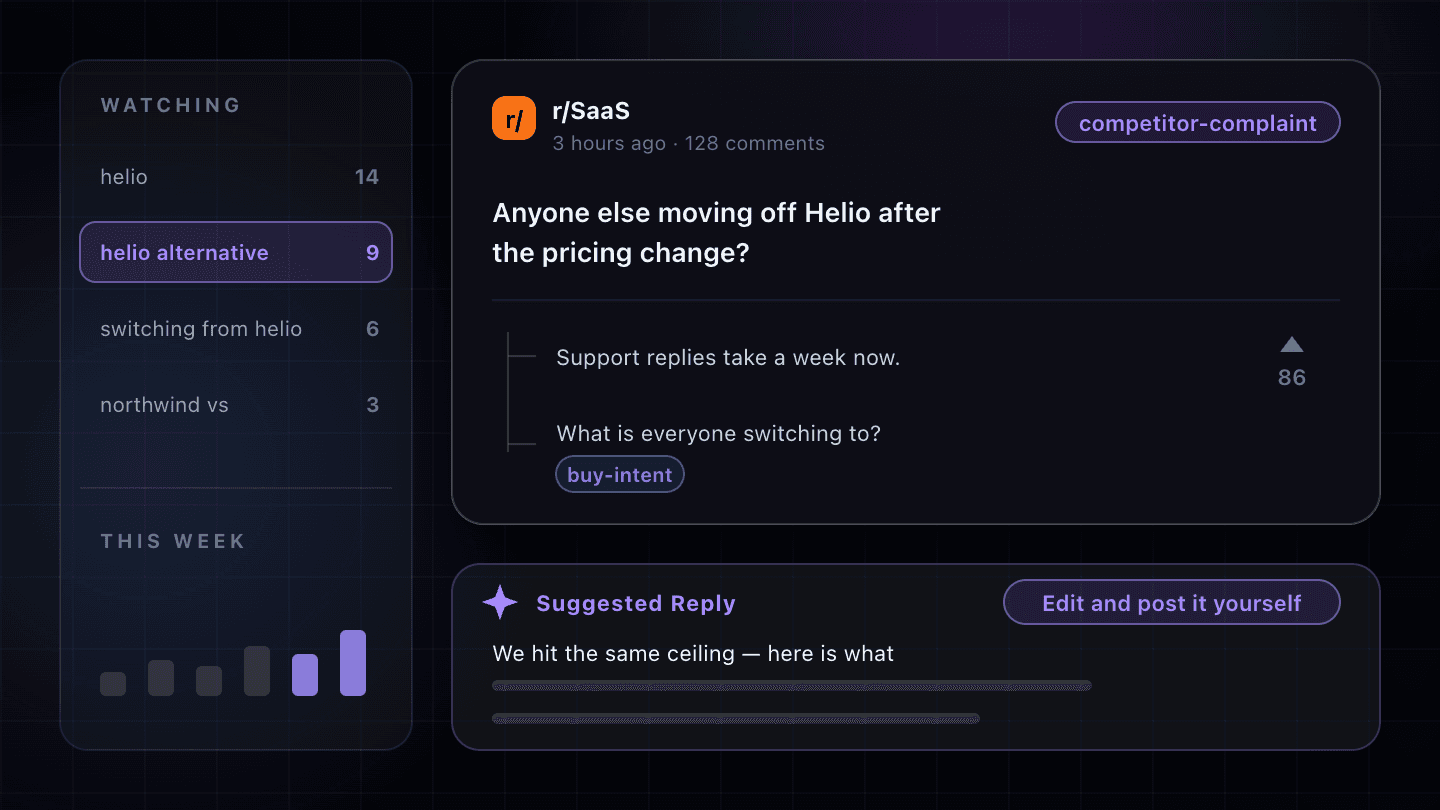
A watchlist rail tracking the keywords “helio”, “helio alternative”, “switching from helio” and “northwind vs” with new-mention counts, beside the r/SaaS thread it caught — tagged competitor-complaint, asking who else is moving off Helio after the pricing change — with a nested buy-intent reply asking what everyone is switching to, and a Suggested Reply draft to edit and post yourself.
The short answer

How do you track competitors on Reddit?

You track competitors on Reddit by monitoring their brand names alongside the language people use when they are leaving — “<competitor> alternative”, “switching from <competitor>”, “<competitor> vs” — and reading the threads that come back. ParseStream watches those keywords across Reddit, X (Twitter), LinkedIn, Quora and Hacker News, alerts you when one appears, and — whenever Lead Detection or an AI Filter is running on that keyword — tags each mention's intent, including competitor complaint.

The opportunity is rarely the complaint itself. It is the person underneath it asking what everyone else is using — and the reply you write there is one you edit and post yourself.

81%

of business buyers say they are dissatisfied with the provider they chose, at the end of a purchase they would call successful.

Source: Forrester (16,000+ buyers)
83%

of B2B decision-makers research on their own before ever speaking to a salesperson.

Source: SurveyMonkey with Reddit
#1

Reddit is the most-cited domain across the AI answer engines Profound tracks, so a complaint thread outlives the week it was posted.

Source: Profound
01

Why do buyers complain about their tools on Reddit?

Almost nobody writes a considered post about software they are happy with. People write when the price went up, when a feature they depended on quietly disappeared, when support stopped answering — and when they write, they usually end with a question. What is everyone else using?

That question is the whole opportunity. It is somebody publicly announcing that they have a budget, a live problem and no remaining loyalty to the incumbent, in a place where you are allowed to answer.

Most of the evaluation happens before you hear about it

Forrester surveyed more than 16,000 global business buyers and found that 81% express dissatisfaction with the provider they choose at the end of a purchase everyone involved would describe as successful — rising to 91% among Gen Z and Millennial buyers. That is not a rounding error. It means a large share of every competitor's customer base is, at any given moment, quietly unhappy.

Where that unhappiness goes has changed. A study SurveyMonkey ran with Reddit among 1,202 US business decision-makers found 83% self-research before ever speaking to a salesperson, and that peer recommendations are the most trusted channel they have: 73% trust peer insights, ahead of vendor websites (55%), search engines (54%), review sites (46%) and AI chatbots (39%). G2's 2025 Buyer Behavior Report, from a survey of 1,169 B2B decision-makers, found nearly two out of three buyers now prefer to talk to a vendor's salespeople only in the later stages of the journey — up 17 percentage points in a year.

Put plainly: by the time a competitor's unhappy user speaks to any vendor at all, the shortlist has already been written. Competitive monitoring is how you get into the room while it is still being drafted.

Why the complaint lands on Reddit and not on a review site

A review site asks for a rating. Reddit asks for a story, and the two produce very different artefacts. A one-star review says the product is bad. A Reddit post says the sync broke every Tuesday, support took nine days to answer, and here is the workaround someone in the comments found. The second is more useful, which is roughly why readers trust it more — in the same SurveyMonkey study, review sites (46%) trail peer recommendations by nearly thirty points.

It is also more durable than a review. Profound's analysis of more than 4 billion AI citations across 300 million answer-engine responses found Reddit is the single most-cited domain at 3.11% of all citations, ahead of YouTube (2.13%) and Wikipedia (1.35%). More pointedly for this topic, Profound found engines cite Reddit for negative brand sentiment (6.1% of citations) at almost exactly the rate they cite it for positive sentiment (5%) — evidence that the models are looking for honest evaluation rather than praise. A thread about your competitor's pricing change is not read only by the fifty people in it. It becomes a source that answer engines draw on when the next person asks whether that competitor is worth paying for.

Reddit's structural position in search reinforces this. Google licenses Reddit content under a deal CBS News reported as valued at roughly $60 million, and Ahrefs' study of roughly 14 billion pages found 96.55% of them get no organic traffic from Google at all. A thread that already ranks is a far better place to be visible than a page you would have to build authority for from nothing.

What competitor tracking is not

Two things are worth ruling out before you build a watchlist.

It is not a way to attack a competitor. Arriving in a complaint thread with a well-timed pitch is the fastest known method of getting downvoted, reported and remembered, and Reddit communities are unusually good at spotting it. The upside of that comment is a click. The downside is becoming the vendor a subreddit warns people about, which is close to permanent.

It is also not a substitute for talking to your own customers. Competitor complaints tell you what is wrong with someone else's product. They do not tell you whether the people complaining would ever have bought yours, and it is very easy to build a roadmap out of grievances belonging to people who were never in your market.

02

What should you actually track, beyond competitor names?

A watchlist made only of brand names underperforms, for a mundane reason: the people most worth reaching often do not name the tool they are leaving until somebody asks them to. They describe the situation instead.

The four buckets below are the set that tends to work. Treat them as four buckets per competitor rather than four keywords in total.

Four kinds of competitor keyword, and what each one catches.
What to trackExampleWhat it catches
Competitor brand names“Helio”, “Helio.io”Everything — praise, complaints, support questions, other vendors. Highest volume, lowest average quality.
Alternative-seeking phrases“Helio alternative”, “alternatives to Helio”People who have already decided to leave and are shortlisting right now. The highest-intent bucket by a wide margin.
Switching and cancellation language“switching from Helio”, “migrating off Helio”, “cancelled Helio”People mid-move, plus the migration questions that show exactly what is hard about leaving.
Comparison phrasing“Helio vs”, “Helio or”Buyers still evaluating both of you. The place to be accurate rather than persuasive.
Four kinds of competitor keyword, and what each one catches. Track your own brand name alongside these. The threads that mention a competitor frequently mention you too, and it is worth knowing how you are being described in a conversation you did not start.
03

How to track competitors on Reddit, step by step

This is the same monitoring loop as any other keyword, pointed at somebody else's brand. What changes is the keyword list and the view you work from.

The ParseStream workflow, in five stepsA left-to-right flow: add your brand, add keywords, get alerted by email or Slack, qualify the mention with AI Filter, Lead Detection and Intent Detection, then edit and post the reply yourself.1Add branddomain + context2Add keywordswhat buyers type3Get alertedemail or Slack4QualifyAI Filter ·Lead Detection ·Intent Detection5Reply manuallyyou edit and post
How a keyword becomes a posted reply. ParseStream drafts the Suggested Reply; you edit it and post it yourself.
  1. Step 1Add your brand and list your competitors

    Adding a brand to ParseStream means giving it your website, a short description of what you sell and who buys it, and a list of competitors — each one a name plus its URL. ParseStream can propose a starting list by reading your website during setup; you can replace or extend it by hand, and edit it later in Brand Settings.

    Be precise about what that list does, because it is easy to over-read. It gives ParseStream the context it uses when suggesting keywords worth tracking. Adding a competitor there does not by itself start monitoring them — that happens in the next step, when the keywords go in.

  2. Step 2Add competitor keywords, per platform

    Add the four buckets above as tracked keywords, and choose which platforms each one runs on: Reddit, X (Twitter), LinkedIn, Quora and Hacker News. A single keyword can run on several at once.

    Two practical notes. Competitors whose names are also ordinary words will match constantly and mean nothing — pair those with a qualifier, such as “Helio pricing” or “Helio support”, or lean on the AI Filter in step four. And keyword allowances are counted per platform and per plan, so when the budget is tight, spend it on the alternative-seeking and switching phrases rather than on bare brand names.

    • “<competitor> alternative” is the highest-yield keyword on most watchlists. Add it first.
    • Add each brand name once — variants like “Helio.io” usually match the same threads twice.
    • Include your own brand name, so you also see the threads where both of you come up.
    • Start with two or three competitors. A watchlist of twelve produces a queue nobody reads.
  3. Step 3Get alerted while the thread is still live

    Matches arrive by email, in Slack, or both. Timing matters more in these threads than almost anywhere else. A post asking for an alternative collects its genuinely useful answers within hours and is effectively finished within a day or two, because the person asking has already decided to move. A perfect reply written a week later is read by nobody.

  4. Step 4Cut the noise with an AI Filter and Lead Detection

    An AI Filter is a rule you write in plain English, attached to a keyword and applied to every mention it produces. For competitor tracking it is the thing that makes bare brand names usable at all — a rule like “only keep posts where someone is dissatisfied with the product, asking about alternatives, or comparing it with another tool” discards most of what a competitor's name matches.

    Lead Detection is the second layer. It checks each mention against your brand context and decides whether it is a genuine lead opportunity for you specifically, which matters here more than usual: plenty of people complaining about a competitor are not remotely in your market, and a queue full of them is how this habit dies in week three.

  5. Step 5Work the competitor-complaint tag, not the Leads view

    Whenever Lead Detection or an AI Filter runs, ParseStream also tags what the mention is — buy intent, product question, competitor complaint, pain point, testimonial or promotional — at no extra credit cost.

    It is worth knowing exactly where those land, because this is the one step people get wrong. The Leads view on the mentions screen is deliberately narrow: approved, high-intent mentions only, meaning buy intent and product questions. Competitor complaints are not in it. To work them, stay on All Mentions and filter by the competitor complaint tag.

    That is the right shape, not a limitation to work around. Your leads queue and your competitive-intelligence queue are read for different reasons, at different tempos, and mixing them makes both worse — one is a list of people to reply to today, the other is a record of what is going wrong in your category.

  6. Step 6Read the Suggested Reply, rewrite it, post it yourself

    ParseStream drafts a Suggested Reply from your brand context and the thread it appeared in. In a competitor thread that draft is a starting point and very little more — the difference between a comment that gets upvoted and one that gets removed is almost entirely in what you cut out of it.

    ParseStream does not post anything. Automatic posting is disabled at the server level by design, so every comment that appears under your name is one you read, edited and sent yourself. In this context that is a feature rather than a missing one: an automated comment in a complaint thread is the exact behaviour communities ban vendors for.

04

How do you reply in a competitor's complaint thread without being the vulture?

The etiquette here is stricter than in an ordinary recommendation thread, for an obvious reason: everyone reading knows you have a commercial interest in the complaint being true. You start as the least trusted person in the room, and the only way out is to behave in a way that somebody working an angle would not bother to.

The most reliable technique is to be useful about the problem rather than about your product. Someone stuck mid-migration has a real question — how do I get my data out, does anything import this format, what breaks on the way. Answer that properly, including the parts that have nothing to do with you, and the disclosure that you build a competing tool reads as context instead of as a pitch.

Say plainly where the competitor is better, when it is. It costs nothing on a thread you were never going to win, and it is the single most credible thing you can do in front of everyone else reading. If the complaint is about something you also handle badly, say that too — being caught overclaiming in a thread about somebody else's overclaiming is a very particular kind of bad day.

  • Never pile on. Agreeing that the competitor is terrible reads as marketing no matter how true it is.
  • Disclose in the comment itself, not in your profile: “disclosure, I work on <product>” before you name it.
  • Answer the question that was actually asked. If the thread is about exporting data, help them export their data.
  • Do not DM the poster. A public complaint is not an invitation to a private pitch, and it is the quickest route to a report.
  • Skip the threads where you have nothing to add. Most competitor mentions do not need you in them at all.
  • If a moderator or the community pushes back, stop. Winning that argument costs more than the thread was ever worth.
05

What does competitor monitoring tell you beyond leads?

The leads are the obvious return and, for most teams, not the largest one.

A month of competitor mentions is a running record of why people leave a product like yours, in their own words, with no survey bias and no reason to be polite. Pricing changes get discussed within hours of the email going out. A removed feature produces a visible spike. The phrases people use to describe the problem become the keywords worth tracking, the objections worth answering on your own pricing page, and — because those same threads are what answer engines quote — part of the material that shapes how your whole category gets summarised to the next buyer who asks an AI about it.

It also changes what you do with your own content. Ahrefs found AI Overviews cut clicks by 34.5%, with position-one click-through falling from a forecast 4.0% to an actual 2.6% where an AI Overview appears, so waiting for people to arrive on your comparison page is a weaker plan than it was two years ago. Being present, accurately, in the thread where the comparison is actually happening is the more durable position.

Two things to hold lightly. Complaint volume tracks a competitor's size at least as much as its quality — a rival with ten times your users will generate roughly ten times the grievance without being ten times worse. And any thread is a self-selected sample of the annoyed; the satisfied majority is not posting. Use this to find conversations and generate hypotheses, not to conclude that a competitor is collapsing.

Frequently Asked Questions

Is it against Reddit's rules to monitor competitors?

Which keywords should I track for a competitor?

Where do competitor complaints show up in ParseStream?

Does adding competitors to my brand start tracking them?

Can ParseStream reply to a competitor complaint for me?

Does competitor tracking work on platforms other than Reddit?

Find out what people say about your competitors

Add your competitors' names and the phrases people use when they leave. ParseStream surfaces the mentions, tags the competitor complaints and buying questions, and drafts a reply for you to edit and post yourself.

3-day free trial · Cancel anytime · You post every reply yourself