Guide · Updated August 2026

Social Listening Keywordsbuild a list that catches buyers, not noise

Almost every monitoring setup that gets abandoned was abandoned for the same reason: the keyword list was wrong, and the tool got the blame. This is the anatomy of a list that works — the five families to build it from, the scoping that keeps it quiet, and the point at which you should stop tuning it by hand.

Updated 18 min readBy the ParseStream team
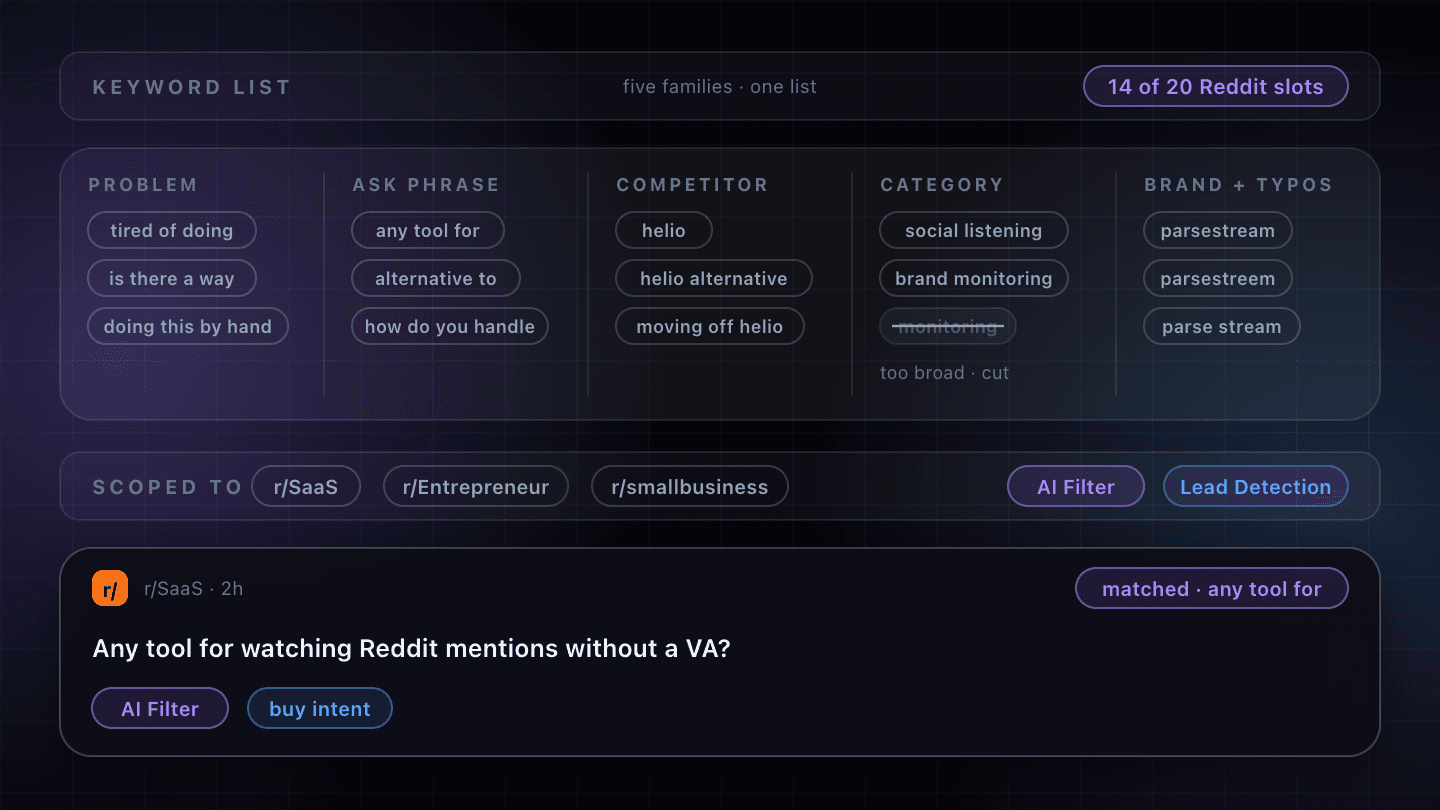
One keyword list of fourteen entries, filling 14 of 20 Reddit slots, laid out as a single panel divided into five labelled columns — problem phrases (“tired of doing”, “is there a way”, “doing this by hand”), ask-phrases (“any tool for”, “alternative to”, “how do you handle”), competitor names (“helio”, “helio alternative”, “moving off helio”), category terms (“social listening”, “brand monitoring”, and a crossed-out “monitoring” captioned “too broad · cut”) and the brand with its misspellings (“parsestream”, “parsestreem”, “parse stream”) — scoped to r/SaaS, r/Entrepreneur and r/smallbusiness with AI Filter and Lead Detection running, above the r/SaaS post it caught asking “Any tool for watching Reddit mentions without a VA?”, marked as matching “any tool for” and tagged buy intent.
The short answer

How do you build a social listening keyword list?

A working social listening keyword list is built from five families rather than one: problem phrases in your customers' own words, ask-phrases like “any tool for” and “alternative to”, competitor names, category terms, and your own brand with its common misspellings. Most lists contain only the last one and a single broad category word, which is why they produce either nothing at all or a queue of mentions nobody opens.

Ten to fifteen keywords across those five families, scoped to the handful of communities your buyers actually use, will out-perform fifty broad ones. Add them, read a week of what comes back, cut whatever produced nothing useful, and promote the phrasing the threads taught you. In ParseStream, an AI Filter and Lead Detection then do the qualifying, and whenever either of those is running each mention also gets an intent tag.

83%

of B2B decision-makers complete their research via peer communities and self-directed search before ever engaging a sales team — in their own words, not your brand name.

Source: SurveyMonkey with Reddit
2 in 3

buyers now prefer to talk to a vendor's salespeople only in the later stages, up 17 percentage points in a year — so the list has to catch the earlier conversation.

Source: G2 (2025 Buyer Behavior Report)
73%

of decision-makers trust peer insights above vendor websites (55%), search engines (54%) and review sites (46%).

Source: SurveyMonkey with Reddit
01

Why do most keyword lists fail?

The typical first list is two entries long: the company name, and one word for the category. It is the obvious list, it takes ninety seconds to write, and it fails in one of two ways within a fortnight.

Either it goes silent — because a company nobody has heard of is a phrase nobody types — or it floods, because the category word turns out to be a common English word attached to a hundred conversations that have nothing to do with you. Both outcomes get read as “this tool does not work.” Both are the list.

Failure one: silence, because nobody knows your name yet

A brand-name-only list assumes your buyers already have you on a shortlist. Almost none of them do. SurveyMonkey's study with Reddit, among 1,202 US business decision-makers, found 83% complete their research via peer communities and self-directed search before ever engaging with a sales team — and they do that research in the language of the problem, not the language of your product page.

G2's 2025 Buyer Behavior Report puts the same shift in terms of timing: nearly two out of three buyers now prefer to talk to a vendor's salespeople only in the later stages, up 17 percentage points in a year. So a list containing only words you chose catches only the people who already found you. Those are worth catching; they are not worth building a monitoring setup for.

Failure two: noise, because one broad word matches everything

The other half of the ninety-second list is a single category term — “monitoring”, “analytics”, “CRM” — and it behaves worse than people expect, for a reason that is mechanical rather than philosophical.

ParseStream matches your keyword as plain text, case-insensitively, with no word boundaries and no stemming. That is deliberate: it means nothing gets invented on your behalf and every mention genuinely contains what you typed. It also means a short keyword matches inside longer words. Track “ai” and you will collect every sentence containing “said”, “chair” and “maintain”. Track “crm” and you are mostly fine; track “ux” and you are not.

Noise is more expensive than silence, because silence is honest. A queue with forty junk mentions in it teaches you to stop opening the queue, and a habit you have stopped opening is worth precisely nothing.

The list is the part you are actually designing

Everything downstream — filtering, scoring, intent tagging, the reply you eventually write — operates on what the keywords caught. No qualification layer can surface a conversation that never entered the queue. Which is the good news: the list is the one part of the setup that is entirely yours, it costs an hour, and it is the difference between a channel and a browser tab you feel guilty about.

02

What are the five keyword families?

A working list is a portfolio. Each family catches a different person at a different moment, and a list missing one of them has a blind spot shaped exactly like the buyer it would have caught.

Two or three entries per family is enough to start. Fifteen well-chosen keywords beat fifty, and they beat them by a wide margin once you are the one reading the results.

The five families, with the kind of entry that works and the kind that quietly ruins the queue.
FamilyWhat to addWhat to avoid
Problem phrases“doing this by hand”, “is there a way to”, “tired of copying”Anything phrased the way your marketing site phrases it. They are not reading your marketing site.
Ask-phrases“any tool for”, “alternative to”, “what do you use for”, “how do you handle”“best” on its own. It is the single most common word in every recommendation thread on the internet.
Competitor namesThe two or three you lose to, plus “moving off <rival>” and “<rival> alternative”A market-map list of twelve. Ten of them are producing nothing and eating keyword slots.
Category termsTwo-word phrases: “social listening”, “brand monitoring”, “keyword monitoring”Single broad words. “Monitoring”, “analytics” and “tracking” each belong to a dozen unrelated conversations.
Brand + misspellingsThe name, the spaced version, and the two spellings people actually typeThe name alone. It is the entry everybody has and the one that explains the empty queue.
The five families, with the kind of entry that works and the kind that quietly ruins the queue. Two or three entries per family is a complete starting list. On ParseStream's Lite plan that fits comfortably inside the 20 Reddit and 20 Hacker News keyword slots, with room left for whatever the first week teaches you.

1. Problem phrases — the words before the category exists

The highest-value and least-used family: people describing the job badly, because they do not yet know there is a word for the software that does it. “Doing this by hand every week”, “tired of copying this into a spreadsheet”, “is there a way to”, “we have someone whose whole job is”.

Nobody here will ever type your brand name and most will not type your category either — which also makes these the least contested conversations you will find, because your competitors are all watching for their own names.

2. Ask-phrases — somebody is choosing right now

The shapes people use when they are asking peers to make a decision for them: “any tool for”, “alternative to”, “what do you use for”, “how do you handle”, “worth it”, “recommendations for”.

Shortest window, highest intent. A thread asking “any tool for watching Reddit mentions?” has its answer chosen within a day or two, and the useful reply is the one that arrived before the thread settled.

3. Competitor names — a shortlist already narrowed

Somebody naming a rival has done the category research for you, and the leaving language around them is better still — “moving off”, “switching from”, “<rival> alternative”, “anyone else having trouble with”. Add the two or three you actually lose to, not the twelve on a market map.

One etiquette rule travels with this family everywhere: in a thread about your competitor you are the least trusted voice present, so answer the question that was asked rather than the one you wish had been.

4. Category terms — but as phrases, not as words

Category terms are worth tracking; single category words are not. “Social listening” and “brand monitoring” are specific enough to be about your category. “Monitoring” on its own turns up in conversations about servers, blood pressure and children.

The test takes a second: could this appear in a sentence that has nothing to do with what you sell? If so, add the word that makes it yours, or drop it.

5. Your brand, plus the ways people get it wrong

Still worth tracking — just not on its own. What most lists miss is the second half: the misspellings, the spaced-out version, the one-letter-off version people type from memory. Matching is case-insensitive, so casing costs you nothing; spelling does.

Say the name out loud and write down what you would type having only heard it once. Those variants belong on the list, along with any former product name still in circulation.

03

How do you stop a keyword list from drowning you?

Three levers, in the order they are worth pulling. The first two cost nothing and are almost always the answer; the third is the one people reach for first and should not.

Think in phrases, and know which match you are using

The single biggest improvement to most lists is adding a word. “Alternative” is a word; “alternative to” is a phrase with intent in it. “Spreadsheet” is a word; “spreadsheet for tracking” is somebody describing the workaround they are about to replace.

It is worth knowing exactly what a multi-word keyword does, because the default is not what most people assume. ParseStream's Broad Match — the default on a new keyword — requires every word to appear somewhere in the text, in any order and any distance apart, so “keyword monitoring” will match a post mentioning keywords in one paragraph and monitoring in another. Phrase Match, the per-keyword toggle beside it, requires the exact phrase in order, as written.

The practical rule: Broad Match for concepts that can be said several ways, Phrase Match wherever word order carries the meaning — brand names, product names, “alternative to <rival>”. Phrase Match is literal about spacing and punctuation too, so “react native” will not match “react, native”: a feature when you want precision, a trap if you turn it on everywhere.

Scope to communities, not to the whole platform

On Reddit you can attach a list of subreddits to an individual keyword, and this is where a broad term becomes survivable. “Monitoring” across all of Reddit is unusable; “monitoring” narrowed to r/SaaS, r/Entrepreneur and r/smallbusiness is perfectly reasonable, because those three communities have already done most of the qualifying for you.

Be precise about what it does, though: the subreddit list narrows results after a site-wide Reddit search, so it can only make a keyword quieter, never surface something the search missed. It is Reddit-specific too — the same keyword on Hacker News, Quora, LinkedIn or X is unaffected. Pick three to five communities, not twenty; if you cannot name three where your buyers actually post, that is a finding about the channel worth having early.

Then, and only then, exclude things

Negative keywords, muted subreddits and blocked accounts are account-level settings in ParseStream, and they earn their place against the recurring offender — the daily job-board bot, the one community that shares your vocabulary and none of your customers. But exclusions are a patch, not a design. If a keyword needs five negatives to be readable, the keyword is wrong.

04

Does the same keyword work on every platform?

The matching rules do, with one exception. ParseStream uses one matcher for all five platforms, so case-insensitivity, Broad Match and Phrase Match behave identically whether a keyword is running on Reddit or on X — except on Quora, where question posts arrive under Broad Match (the schema default) without a strict keyword-text match, so a Quora keyword surfaces related questions rather than only ones containing the exact words. Phrase Match restores strict text matching for Quora questions.

What differs is the text a keyword has to land in — and that is what should change how you word it.

What a keyword actually reaches on each platform, and what that means for how you phrase it.
PlatformWhat a keyword reachesHow to word it
RedditPosts and comments, and the only platform with per-keyword community scoping.The one place a broad term is safe, because you can pin it to three subreddits. Comments are matched on their own text, not the post title, so the phrase has to appear in the comment itself.
Hacker NewsStories and comments. A link submission has no body text, so its title is the whole of what a keyword can match.Keep at least one keyword short enough to plausibly appear in a headline. The long problem phrases earn their keep in the comments instead.
QuoraQuestions and answers. Under Broad Match, questions skip the local keyword-text check and pass on Quora's own search relevance instead; Phrase Match brings the strict check back.The ask-phrase family does most of the work here, because the unit of content is literally a question. Answers are matched on the answer text, not on the question they sit under.
LinkedInPosts only — comments are not covered.Anything you would only expect to find in a reply is wasted here. Favour phrases somebody would put in a post of their own: announcements, switches, “we finally stopped doing X by hand”.
X (Twitter)Posts and replies.The shortest text of the five, so long phrases rarely appear verbatim. Keep X keywords tight, and avoid X's own search syntax inside a keyword — characters like “from:” or a leading minus are interpreted by X's search, not by us.
What a keyword actually reaches on each platform, and what that means for how you phrase it. Keyword allowances differ by plan and by platform. Lite covers Reddit and Hacker News only, at 20 keywords each; Pro adds 10 each on Quora, LinkedIn and X alongside 60 Reddit and 60 Hacker News; Growth runs 150/150/25/25/25.

A note on cost, because it changes the list

LinkedIn and X meter at retrieval — LinkedIn 1 credit per post and X 0.5 per item — before keyword-matching narrows anything down. Reddit, Hacker News and Quora meter later: the cost starts at the AI-check stage, once a mention has already matched a keyword, not at retrieval. That inverts the usual advice: a sloppy keyword on LinkedIn or X costs you before a single result was even evaluated.

So do your loose, exploratory phrasing on Reddit and Hacker News, where mistakes are cheap, and move a phrase onto LinkedIn or X once you already know it works.

05

How do you improve a keyword list after the first week?

By reading it, once, properly. Not by adding more keywords, which is what everybody does and what makes the second week worse than the first.

There is a useful accident of how monitoring starts: when you add a keyword to ParseStream it runs immediately and pulls a week of Reddit posts and Hacker News history with it, so you get a read on whether a phrase was any good within minutes rather than waiting for new conversations to happen. After that, each keyword is re-checked about once an hour.

  1. Step 1Add the list, then leave it alone for seven days

    Resist tuning on day two. A single quiet day tells you nothing — plenty of good keywords produce two mentions one week and eleven the next. The one thing worth doing early is checking the backfill: a keyword that returned nothing at all from the previous week on Reddit or Hacker News is telling you something about the phrase, immediately.

  2. Step 2Sort what came back into three piles

    Open a week's mentions and mark each one: worth replying to, real but not for you, and junk. Do it in one sitting, because the value is in the pattern rather than in any individual mention.

    The ratio per keyword is the whole diagnostic. A keyword producing four mentions of which three were worth replying to is your best keyword, even though it is your quietest.

  3. Step 3Cut the silent ones and the loud ones

    Two failure modes, two fixes. A keyword that produced nothing is usually phrased the way you talk rather than the way your buyers do — rewrite it from a sentence you actually read in one of the good threads.

    A keyword that produced volume and no value is almost always too broad. Add a word to make it a phrase, scope it to three subreddits, or turn on Phrase Match. Deleting it is also fine; the slot is worth more than the keyword.

  4. Step 4Promote the language the threads taught you

    The step that compounds, and the reason to read a week rather than skim it. Somewhere in the good mentions are three or four phrasings you would never have written down — the specific way people describe the problem, the nickname they use for the category, the workaround they name. Add those verbatim. Keywords lifted out of real threads consistently outperform keywords invented at a desk.

  5. Step 5Keep the list around fifteen entries

    For every keyword you promote, retire one. A list that only grows drifts back towards the flood it started as, and a fixed size forces the comparison that keeps it sharp: is this new phrase better than the weakest thing already on the list? Re-run the exercise quarterly, or whenever a competitor launches, you reposition, or the category acquires a new buzzword.

06

When should you stop tuning and let scoring handle it?

Around week three, or the first time you catch yourself trying to write a keyword that means “but only when they are serious”. That is not a thing a keyword can express — it is a judgement about a sentence, and it is the point at which the list has done its job and something else should take over.

The division of labour is worth stating plainly, because getting it backwards is what makes people over-engineer their keywords: keywords decide what gets looked at, and scoring decides what reaches you. Keywords should be a little too generous. That is what the filtering is for.

An AI Filter is the rule your keyword could not express

An AI Filter is a plain-English instruction attached to a single keyword — “only keep posts where someone is choosing between tools”, “ignore anything that is just a complaint about pricing”. Every mention that matched the keyword is checked against that sentence before it reaches you.

It is the right home for every condition people try to smuggle into a keyword. Once the filter is written you can usually loosen the keyword underneath it, which widens what you catch and narrows what you read at the same time.

Lead Detection asks whether it is a lead for you

The second pass asks a different question: not “does this match the rule” but “is this person a plausible customer for this brand”. It reads your brand description, what you sell and who buys it, and scores each mention against that. Which is why the description is worth ten minutes rather than one line — a vague one produces vague qualification.

Intent tagging tells you which queue to open first

Whenever Lead Detection or an AI Filter is running on a keyword, ParseStream also tags what each mention actually wants — buy intent, product question, competitor complaint, pain point, testimonial or promotional — at no extra credit cost. The Leads view collects the two highest-intent tags so the queue you open on a busy morning is short.

That tag is also the honest feedback loop on your list. A keyword producing nothing but promotional and testimonial tags is catching marketers rather than buyers, which is worth knowing before you spend another month on it.

What that leaves you doing

Reading a short queue and writing replies. ParseStream drafts a Suggested Reply from your brand context and the thread it appeared in; you edit it and post it yourself, because automatic posting is disabled at the server level by design rather than for want of building it.

There is a cost argument for the same discipline. Each AI pass costs a credit per mention it checks, and an approved mention costs one more, so a list producing less rubbish is also a cheaper one. The tightest list is usually the one that pays for itself twice.

Frequently Asked Questions

How many keywords should I track?

How many keywords does each ParseStream plan include?

Should I use phrase match or broad match?

Should I track my own brand name?

Why am I getting irrelevant mentions for a keyword?

Do I need to re-do my keyword list regularly?

Sources

Every statistic on this page comes from the published research below and was last checked in August 2026. Search and AI-citation data moves quickly, so treat the figures as a snapshot of 2026 rather than a permanent state of affairs.

Write the list once, then let the scoring do the rest

Add ten to fifteen keywords across the five families and ParseStream watches Reddit, Hacker News, Quora, LinkedIn and X for them, qualifies what comes back, tags what each person actually wants, and drafts a reply for you to edit and post yourself.

3-day free trial · 20 Reddit and 20 Hacker News keywords on Lite · You post every reply yourself