Guide · Updated August 2026

Quora Lead Generationanswers that keep selling for years

Every other community channel is a conversation with a half-life. Quora is the one place where the question stays open, keeps ranking, and keeps sending you people long after you stopped thinking about it. This is how to pick the questions worth answering, how to catch them while they are still new, and how to write an answer that is still working in three years.

Updated 18 min readBy the ParseStream team
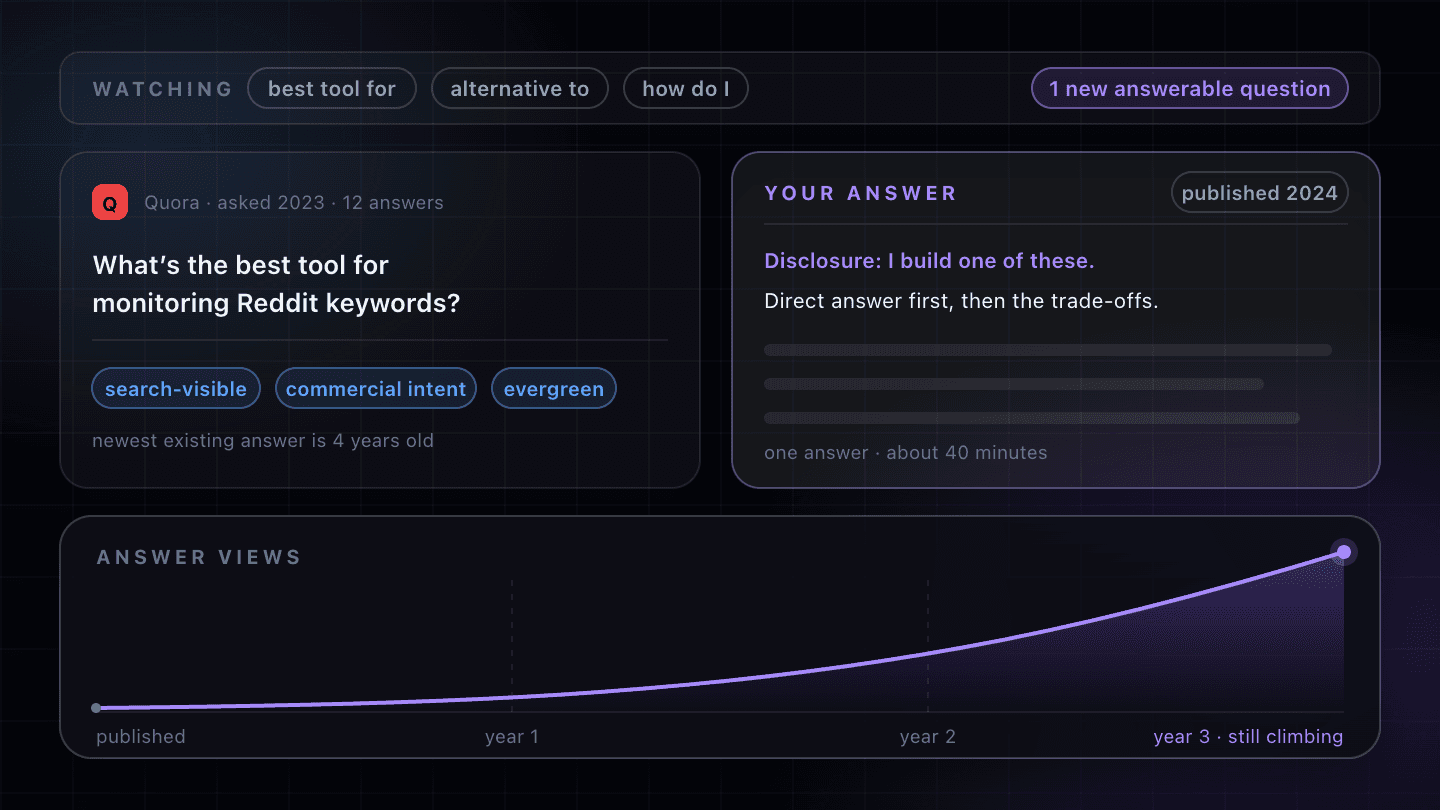
A monitoring strip watching the keywords “best tool for”, “alternative to” and “how do I” flagging one new answerable question, above a Quora question asking “What's the best tool for monitoring Reddit keywords?” — marked search-visible, commercial intent and evergreen, its newest existing answer four years old — beside the answer published against it in 2024, opening “Disclosure: I build one of these.”, over a chart of that answer's views leaving the baseline slowly and still climbing three years later.
The short answer

How do you generate leads on Quora?

Quora lead generation means finding the questions your buyers already ask on Quora, answering them well enough to be genuinely useful to a stranger, and letting those answers keep working. What separates it from Reddit or X is time: a Quora question is built to be permanent, so one good answer keeps being read — and keeps sending people to you — for years after the forty minutes you spent writing it. ParseStream monitors Quora for the phrases that signal an answerable question and, whenever Lead Detection or an AI Filter is running on that keyword, tags what each mention actually wants.

Two things to know before you start. It compounds on a scale of months, not weeks, and the first fortnight will feel like nothing is happening. And Quora keyword monitoring needs a Pro plan or above — ParseStream's Lite plan covers Reddit and Hacker News only.

400M+

monthly unique visitors Quora tells advertisers it reaches, most of them arriving to read an answer somebody else already asked for.

Source: Quora for Business
1 in 14

Google AI Mode answers included a Quora link, making it one of the four most-cited sources in Semrush's study.

Source: Semrush
73%

of B2B decision-makers trust peer insights above vendor websites (55%), search engines (54%) and review sites (46%).

Source: SurveyMonkey with Reddit
01

What makes Quora different from Reddit or X?

Every other community channel is a conversation with a half-life. A Reddit thread collects its useful answers within a day and is closed within a week. On X the window is hours. You reply, it works or it does not, and either way it is gone by Thursday.

Quora inverts that. A question there is not an event but a page — a permanent URL that keeps collecting answers, keeps being shown to new readers, and keeps turning up in search long after whoever asked it stopped caring. That one difference changes what a good answer is worth, and it is why Quora needs its own playbook rather than your Reddit habits pointed at a new logo.

The asset is the answer, not the conversation

On Reddit you are buying attention inside a window. On Quora you are building an asset. The forty minutes spent answering “what's the best tool for X” properly is a one-time cost against a return arriving in instalments for years — which also means a lazy answer is a permanent one, sitting under your name.

That flips the economics of effort. On Reddit, ten quick useful replies beat one essay, because nine of those threads are dead tomorrow regardless. On Quora the reverse holds: one long, specific, hard-to-write answer out-earns twenty short ones, because only the long one survives the reader who finds it three years from now.

The audience arrives from search, holding the problem

Quora tells advertisers that “Over 400 million unique visitors come to Quora every month looking for answers” — its own figure, not an independent measurement, so read it as scale rather than a count. The number that matters more is underneath it: Semrush's overview of quora.com put the site's organic search traffic at 188.9 million in its June 2026 snapshot. Almost nobody browses Quora the way they browse a feed. They land on one question, usually from a search engine, already holding the problem.

That posture is what makes the patience worth it. SurveyMonkey's study with Reddit, among 1,202 US business decision-makers, found 73% trust peer insights above vendor websites (55%), search engines (54%) and review sites (46%). An answer from an identifiable person who has obviously done the work sits on the trusted side of that gap; your landing page cannot.

And increasingly the reader is a machine

The evergreen argument has grown a second half. Semrush built a dataset of 278,279 unique prompts and identified 26,000 unique Quora URLs cited at least once by Google's AI Mode. Its finding: “Quora is one of the top 4 sources in AI Mode: About 1 in 14 answers (7.25%) included a Quora link, making it one of the most-cited domains.”

Profound's separate analysis of 4 billion AI citations measures something different and gives a much smaller-looking number: Quora at 0.39% of all citations across models, tenth in a table led by Reddit (3.11%) and YouTube (2.13%). The two do not conflict. 7.25% is the share of AI Mode answers containing at least one Quora link; 0.39% is Quora's share of every individual citation counted across engines. Different denominators, same conclusion — what you write there gets quoted to people who never visit the page.

This is what most changes how you write. An answer built to be lifted — conclusion first, specifics checkable — travels further than one built to be scrolled.

What Quora is not good for

It is not fast, and it is not fair. Nothing you write will do anything measurable in week one. The questions that matter most often already carry answers with a decade of votes on them, and Quora's ordering is opaque enough that you will never fully know why one of yours took and another did not.

It is also not a growing platform, and a guide that skipped that would be selling you something. The same Semrush snapshot recording 188.9 million organic visits notes that “Quora.com's traffic has dropped by -1.79% month-on-month” — one month rather than a curve, and a modelled estimate rather than a measurement. A slowly shrinking platform with hundreds of millions of search visits is still a large channel, just not one to build a business on alone.

So do not fund this quarter with it. If you need conversations this month, monitor Reddit and X and let Quora compound underneath them.

02

Which Quora questions are actually worth answering?

Most of them are not. Quora carries an enormous tail of questions nobody will ever search for, phrased so they will never rank, asked by people with no intention of buying anything. Answering those diligently for a month is how most people conclude Quora does not work.

Three tests sort the questions worth forty minutes from the ones worth nothing. Each takes about fifteen seconds, and all three have to pass.

The same three tests, applied to the kinds of questions you will actually be looking at.
The questionAnswer it?Why
“What's the best tool for monitoring Reddit keywords?”YesCommercial intent, undated phrasing, and the sort of thing people search rather than browse. This is the shape worth forty minutes.
“Best project management software in 2024”NoDated in the title. It started decaying the day it was posted, and answering it well changes nothing about that.
“How do I track mentions of my brand without paying for a tool?”YesA pain point with a workaround inside it. Somebody doing the job by hand is the cheapest customer you will ever find, and they asked in public.
“Is [competitor] worth the money?”Yes, carefullyHigh intent, low competition, and you are the least trusted person in the thread. Disclose first, answer honestly, and be prepared for the honest answer to be yes.
“What is social listening?”RarelyDefinitional. It draws students and content writers rather than buyers, and the ranking belongs to sites with far more authority.
A 2016 “X or Y?” question with forty existing answersUsually noVotes compound too, and a settled order rarely reshuffles for a latecomer. The exception worth taking: every existing answer is now factually out of date.
The same three tests, applied to the kinds of questions you will actually be looking at. When two questions pass all three tests, take the one with fewer and older existing answers. Being early on a permanent page is the one advantage on Quora that never expires.

One: is it search-visible?

Paste the question into a search engine. If the Quora page already ranks on the first two pages, the traffic exists and you are deciding whether to compete for it. If nothing on the topic ranks, you are writing into a void.

This is what most separates Quora from Reddit. On Reddit the audience is the subreddit, there whether or not Google agrees. On Quora, search is most of the audience — so a question search has never heard of has almost none.

Two: does it carry commercial intent?

“Best tool for X”, “X vs Y”, “is X worth the money”, “how do I stop doing X manually” — all asked by somebody in the process of spending money. “What is X” is not. Definitional questions draw students and content writers, and their rankings belong to sites with far more authority.

The highest-intent shape names a competitor. Someone asking whether a specific product is worth it has narrowed the field to one, and the vendor is the least credible voice in that thread — which leaves the honest third party holding the audience.

Three: is it phrased to last?

The test unique to an evergreen channel, and the one people skip. “Best CRM for a small agency” still makes sense in 2031. “Best CRM in 2024” was decaying the day it was posted, and answering it well changes nothing.

So the fastest disqualifier is a year in the title. Skip it and find the undated version of the same question — on a platform this size it almost always exists, usually with more traffic.

03

How do you find new questions worth answering?

By hand, at first — and for the first week you should. Searching Quora for your problem in a customer's words is how you learn which phrases are worth tracking. It stops working for the reason manual search always does: it depends on you remembering, daily, indefinitely.

There is a counter-intuitive reason to automate it here. An evergreen channel still has a short opportunity window — but the window is on the question, not the answer. A question with no answers yet is one where yours can become the top one and stay there. On Reddit, being late costs a thread. On Quora, it costs a position you would have held for years.

  1. Step 1Add your brand before you add a single keyword

    The website, a short description of what you sell and who buys it, and the competitors you keep losing to. Every qualification step downstream reads from that description, so a vague one produces vague filtering.

    Quora keyword monitoring requires a Pro plan or above — ParseStream's Lite plan covers Reddit and Hacker News keywords only. If Quora is the channel you came here for, that decision is better made now than after a week of setup.

  2. Step 2Track the phrase families that produce answerable questions

    Not your product name — nobody on Quora is typing it yet, and the handful who are will find you anyway. Track the shapes of question that indicate somebody is choosing.

    • Problem phrases in the customer's words: “how do I keep track of”, “is there a way to”, “tired of doing this manually”.
    • Category and comparison terms: “best tool for”, “alternative to”, “vs”, “worth it”.
    • Competitor names on their own — the highest-intent questions on the platform, and the ones your rival cannot answer credibly.
    • The workaround people use instead: “spreadsheet for”, “free way to”, “script that”. Someone describing a manual process is describing a purchase they have not made yet.
  3. Step 3Cut the noise with an AI Filter and Lead Detection

    Raw keyword matching is blunt, and blunt means a queue you stop opening. An AI Filter is a rule you write in plain English and attach to a keyword — “only keep questions where someone is choosing between tools or describing a problem we solve”.

    Lead Detection is the second pass, checking each mention against your brand context to decide whether it is a genuine lead opportunity for you rather than a question that merely contains your words.

  4. Step 4Triage by intent before you commit forty minutes

    Whenever Lead Detection or an AI Filter runs, ParseStream also tags what each mention is — buy intent, product question, competitor complaint, pain point, testimonial or promotional — at no extra credit cost. That tag does more work on Quora than elsewhere, because answering costs more: a Reddit reply you regret cost four minutes, a Quora answer you regret cost most of an hour and is still there.

    Take product questions and buy intent first. Pain point is the slower, better queue — someone describing the problem without knowing a category exists is the least contested answer you will write.

  5. Step 5Write it, publish it, and leave it alone

    ParseStream drafts a Suggested Reply from your brand context and the question it appeared under. That draft needs more rewriting on Quora than on Reddit, because the finished thing has to stand alone for years rather than make sense inside a live conversation.

    ParseStream does not post it. Automatic posting is disabled at the server level by design, so every answer published under your name is one you wrote, edited and submitted yourself.

04

How should a Quora answer be structured?

Like an answer to a question, which is rarer than it ought to be. Quora's house style rewards performance — the long preamble, the anecdote arriving at the point around paragraph nine — and it is the wrong instinct when the reader came from a search engine holding a specific question and a back button.

Answer in the first two sentences

Say the thing. If the question is “what's the best tool for X”, the first line names a tool and the reason; everything after is justification. Nobody has ever resented an answer for being clear too early.

There is a second reason to front-load it now. An answer that survives being lifted out of context is the kind pulled into a search snippet or quoted by an AI engine — increasingly where it will be read. A conclusion buried in paragraph nine does not travel.

Then earn it with something only you could write

The middle is where credibility gets spent. A number, a limitation, a thing that broke, the case where the obvious choice is wrong — details expensive for a content marketer to fabricate and free for you, because you did the work.

Generic comparison prose is the commonest reason a well-targeted answer does nothing. If it could have been written by someone who never used any of the products in it, it will perform exactly as well as one that was.

Recommend the competitor when the competitor is right

The answers that convert best name more than one option and are honest about which reader each suits. On a page read by hundreds of people across three years, a recommendation right for eighty per cent of them and candid about the other twenty beats a pitch right for nobody.

It is also the only version that survives someone arriving from a search for your competitor's name — which, on a question naming them, is most of the audience.

Come back only when it is wrong

The one maintenance job an evergreen answer needs is a correction pass when a fact goes stale: a price you quoted, a product that shut down, a limitation since fixed. Editing for polish achieves nothing; editing because the answer now misleads is the difference between an asset and a liability.

05

What does Quora actually allow on self-promotion?

More than most people assume, with one condition most people ignore. Quora's Question and Answer Policies do not ban mentioning your own product — they ban mentioning it in a way that is not itself a useful answer. The wording rewards reading as written rather than as remembered:

“Self-promotional links or self-promotion that does not form a part of a direct and helpful response to the question is not allowed,” the policy states, adding that “The gist of the answer should be able to be understood without having to leave Quora to access an external website.” Affiliate links get no such conditional treatment — “Affiliate links are not allowed.”

Read carefully, that is a design brief rather than a restriction: the answer has to work as an answer, on the page, without the click. Which is also what makes it rank, what makes it quotable, and what makes a stranger believe it.

The disclosure rule is explicit, and it is not onerous

The same page is direct about affiliation: “A user should disclose any relevant affiliations explicitly in an answer or in the credential that appears with the answer.” Quora's dedicated help article is more specific about what that means when the product is yours — “the answer (or answer credential) should make clear the user's affiliation with the company.”

It is not a demand for a legal notice. “This disclosure can be brief and does not need to be set off separately, as long as it is clear,” that article says, so half a sentence in your opening paragraph satisfies it. The bar for what counts is deliberately wide: “A relevant affiliation is any involvement that a reasonable observer would think is important for interpreting the views that the user expresses in an answer.” Advising a company or holding equity counts, not just working there.

In practice: “Disclosure, I build one of these” before you name it, every time, inside the answer rather than only in a profile credential nobody reads. It costs nothing, and it removes the only argument for taking your answer down.

What still gets an answer removed

  • Answering in order to link, rather than linking in the course of answering. This is the distinction the policy is built around.
  • Posting the same answer under thirty different questions. It reads as what it is, and it is the fastest way to lose the account.
  • Affiliate links, which are banned outright with no helpfulness exception.
  • An answer whose gist genuinely cannot be understood without clicking through — named directly in the policy above, and the trap that catches people who think a teaser paragraph plus a link is a contribution.
  • Multiple accounts, or arranging upvotes. Every platform in this set treats that as unforgivable, and unlike a removed answer it is not recoverable.
06

How long does Quora take, and how do you know it is working?

Months. The honest shape is: nothing, nothing, nothing, then a trickle that does not stop.

The first four to six weeks produce almost nothing measurable, and that is when nearly everybody quits. What is happening is indexing and ranking — neither of which you control, both of which take longer on a page earning its position against answers with years of votes behind them.

Somewhere in month two or three the pattern changes. One answer starts producing a steady handful of profile views and site visits every week without you touching it, and keeps doing it the week after. That is the whole mechanic — and once one answer does it, you can stop guessing which questions deserve your time.

The compounding is real but not exponential, and anybody selling it as exponential is selling something. Ten good answers produce ten independent trickles of very different sizes, two of which account for most of the total. Plan on writing more answers than will work — you cannot pick the two in advance.

What to measure

Almost every disappointing Quora report is a measurement problem rather than a channel problem — a fortnight of data on a channel whose unit of time is the quarter.

  • Views per answer over time, not in the first week. The number that matters is whether month three is higher than month one, and for a working answer it will be.
  • Referral traffic from quora.com in your own analytics — the only figure in this list that belongs to you rather than to Quora.
  • Which questions produced those views. One or two will dominate, and they define what you go looking for next.
  • Conversations and signups that mention the answer. It is the only measurement that survives an argument about attribution.

A fair budget for testing the channel

One good answer a week for three months, with monitoring doing the finding so your effort goes into writing rather than searching. Roughly twelve answers and fifteen hours across a quarter.

If twelve good answers to well-chosen questions produce nothing in three months, your buyers are not on Quora — a real answer, arrived at cheaply. The failure mode to avoid is not a channel that does not work; it is abandoning one at week five, roughly the week before it would have started to.

Frequently Asked Questions

Do I need a paid plan to monitor Quora keywords in ParseStream?

How long before a Quora answer starts producing leads?

Is promoting my own product against Quora's rules?

Should I answer brand-new questions or old ones with lots of answers?

Does ParseStream post Quora answers for me?

Is Quora still worth it compared to Reddit?

Catch the questions while they are still new

Add the phrases your buyers use when they are choosing, and ParseStream surfaces the Quora questions worth answering, tags what each person actually wants, and drafts an answer for you to rewrite and publish yourself.

3-day free trial · Quora keywords included from Pro · You publish every answer yourself