Guide · Updated August 2026

Is Quora Still Worth It for Lead Generation in 2026?an honest answer, including “no”

For some niches Quora is still one of the best hours you can spend, and for others it stopped being worth opening. This page is the decision — what actually changed, what the monitoring market did about it, where Quora still pays, and how to work out which of those two you are. It is not a how-to; when the answer comes out yes, the tactics are one link away.

Updated 19 min readBy the ParseStream team
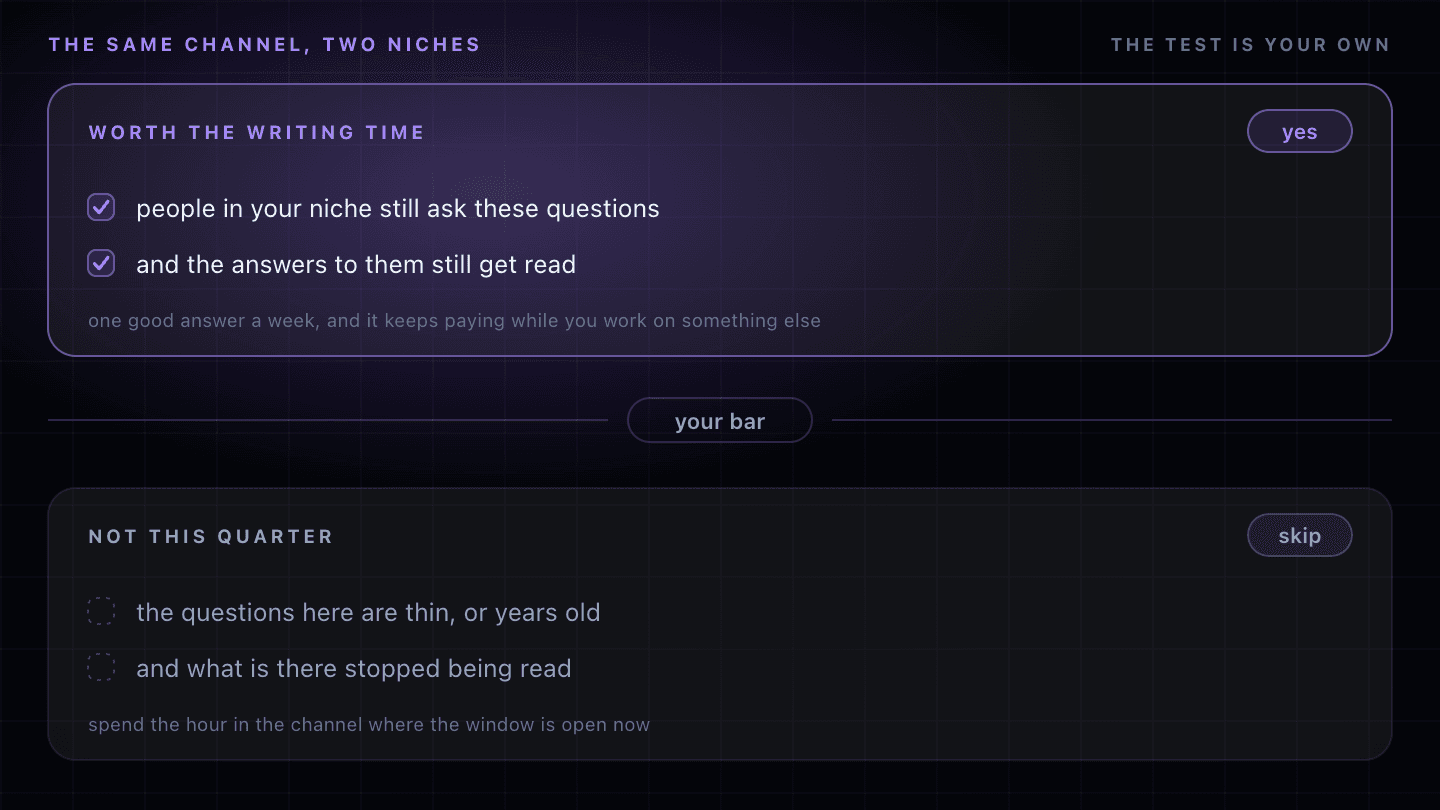
Under a heading reading “THE SAME CHANNEL, TWO NICHES” and a note reading “THE TEST IS YOUR OWN”, a lit card outlined in violet is headed “WORTH THE WRITING TIME” beside a violet pill reading “yes”. It carries two ticked conditions — “people in your niche still ask these questions” and “and the answers to them still get read” — over the line “one good answer a week, and it keeps paying while you work on something else”. A hard rule runs the full width of the frame beneath it, broken in the middle by a pill reading “your bar”. Below the rule, an identically sized card sitting in shadow is headed “NOT THIS QUARTER” beside a grey pill reading “skip”, carrying the same two conditions with empty dashed boxes — “the questions here are thin, or years old” and “and what is there stopped being read” — over the line “spend the hour in the channel where the window is open now”.
The short answer

Is Quora still worth it for lead generation in 2026?

Sometimes, and the honest answer is a test rather than a verdict. What changed is real: the searches Quora lives on are question-shaped, and question-shaped searches are the ones AI answers absorb first — Pew found 60% of Google queries beginning with a question word returned an AI summary, and Seer measured an AI Overview on 85.9% of question-format queries, 1,214 of the 1,413 it tested. Some monitoring vendors have stopped covering Quora entirely; Syften's changelog records “2025.10.17 Quora scraper is shut down.”

What has not changed is that a Quora question is still a permanent page, and that answer engines quote it heavily: Semrush found a Quora link in 7.25% of Google AI Mode responses, about one answer in fourteen, and one of the four most-cited domains in that study. So Quora is worth it if your buyers still ask your category's questions there and those answers still get read — and it is genuinely not worth it if they do not. Work through the checklist below before spending a quarter on it.

85.9%

of question-format queries returned an AI Overview — 1,214 of the 1,413 Seer tested, and the query shape Quora's whole audience arrives on.

Source: Seer Interactive
1 in 14

Google AI Mode responses included a Quora link — 20,189 citations across 278,279 prompts, one of the four most-cited domains Semrush measured.

Source: Semrush
2025.10.17

the date on Syften's changelog entry reading “Quora scraper is shut down” — one vendor's published decision, and not the whole market's.

Source: Syften
01

What actually changed since Quora was an easy yes

Quora's case was always the same one: a question there is a permanent page, so a good answer keeps being read for years rather than scrolling away in an afternoon. That mechanic still works exactly as advertised. What changed is the road people used to arrive on.

Two of the three things below are measured and the third is Quora describing its own company in its own words. None of them is a traffic curve, and that is deliberate: every chart claiming to show Quora's decline that we could trace resolves to a third-party estimator, which models traffic rather than measuring it and republishes itself on a schedule — the tool page most often cited restamped its own title from June to July 2026 between one check and the next, while the citations pointing at it stayed still. A number that moves under a footnote that does not is not something to decide a quarter on, so this page argues from things that can be dated and re-checked.

Google now finishes the question on the results page

Almost nobody browses Quora. Its arrivals are single-page and search-shaped: a person types the problem they already have, and a question page is what the engine hands back — which is precisely the traffic AI answers have taken the largest bite out of. Pew Research Center, tracking the browsing of 900 U.S. adults across 68,879 Google searches, found that 60% of queries beginning with a question word — who, what, when, why — returned an AI summary. Seer Interactive's 2026 study puts a sharper number on the shape: question-format queries returned an AI Overview 85.9% of the time, which is 1,214 of the 1,413 queries matching that format rather than a rate measured across its whole sample, so read it as a confident ordering on a modest base.

That is not a Quora-specific finding and it is not a claim about Quora's traffic. It is a claim about the query type Quora is built on, which makes it the single most important input to this decision. Our guide to what AI Overviews are doing to blog traffic has the full picture.

Quora is being cited more than it is being clicked

The second half of the same change cuts the other way, and it is the reason this page is not a straightforward no. Semrush built a dataset of 278,279 unique prompts, identified 26,000 unique Quora URLs cited at least once by Google's AI Mode, and found a Quora link in 7.25% of responses — 20,189 citations, about one answer in fourteen, and one of the four most-cited domains in the study behind only LinkedIn, Reddit and Google.

Then read the sentence next to it: “On average, there was less than 50% overlap between an AI Mode answer and the closest Quora reply. This shows that Google blends multiple inputs rather than quoting directly.” That is the whole tension of 2026 stated by one publisher in two lines. Your answer is being used. It is being rewritten while it is used. Whether the person reading it ever lands on the page is a separate question from whether your argument reached them.

Keep the denominators apart, because the two AI figures look contradictory and are not. Profound's larger sample — over 4 billion citations across 300 million answer-engine responses — puts Quora at 0.39% of all individual citations, tenth in a table led by Reddit at 3.11%. Semrush's 7.25% is the share of AI Mode answers containing a Quora link; Profound's 0.39% is Quora's share of every citation counted. Both are true, and together they say Quora is a real but minority source rather than a dominant one.

What Quora publishes about Quora

The company's own careers site describes what it is now building: “We build platforms that increase the pace at which humanity can grow its collective intelligence. This includes knowledge sharing among humans (Quora) and collaboration among humans and all kinds of AI (Poe).” Its products section lists two — Quora, “a global knowledge sharing platform with hundreds of millions of monthly unique visitors”, and Poe, which “aggregates access to the best models from many different AI companies in a single chat interface”. That is a company statement rather than a traffic statement, and it is worth exactly what it says: the question-and-answer site is one of two platforms its owner describes itself as building, and the other is an AI product.

The advertiser side is more concrete, and it is on Quora's own pages. Quora sells Promoted Answers, which place a brand “directly within relevant answer threads”; Image Ads that “Automatically convert to text ads on question pages”; Text Ads written to blend “seamlessly with Quora's question-and-answer format”; and Lead Gen Forms that “Capture qualified leads directly within the Quora platform, eliminating landing page friction”. Read that last one as a competitor rather than a complaint: the platform sells advertisers a way to take the lead without the reader ever leaving — the same lead your organic answer was hoping to send somewhere.

02

The signal from the tools that used to watch Quora

There is a market signal here worth more than any estimator, because it is companies making a costly decision in public. Monitoring vendors have to build and maintain a collector for every platform they cover, and they publish the list because it is what customers buy on. When one removes a platform, that is a dated fact rather than an opinion.

Everything below is what these companies publish about themselves. The inferences drawn from it are deliberately narrow, and where one is made it is labelled as such rather than left to sit inside the quotation; nothing else on this page names a vendor.

What the vendors publish

Syften's changelog carries a dated line: “2025.10.17 Quora scraper is shut down.” Its homepage FAQ, answering “Which communities does Syften monitor?”, enumerates eighteen sources — the public web, Reddit, X/Twitter, Indie Hackers, Hacker News, GitHub, ProductHunt, the Stack Exchange family, forums, Lobste.rs, Dev.to, Steemit, Slack communities, newsletters, YouTube, podcasts, Bluesky and Mastodon — and Quora is not among them. The two agree with each other, which is why both are quoted rather than only the first.

Two other tools in the category do not list Quora among their supported platforms at all. Octolens enumerates fourteen — Reddit, X, LinkedIn, Hacker News, GitHub, YouTube, Bluesky, TikTok, DEV, Stack Overflow, podcasts, newsletters, news and the open web — each with its own page, and Quora appears on none of them. In fairness to the vendor, the same site also describes itself in round numbers as monitoring “15+ platforms”, so the named list is the smaller of its own two counts; we quote the enumeration because it can be checked name by name, and note the larger figure rather than leaning on the gap. F5Bot states plainly that it “monitors Reddit, Hacker News, and Lobsters for your keywords”.

And one has not dropped it. Brand24's pricing page carries a per-tier source matrix that lists Quora and marks it included on four of its five plans. If this section only quoted the shutdown, it would be selecting its evidence, and the honest version of a market signal includes the vendor going the other way.

What that does and does not tell you

Be careful, because the tempting reading is the wrong one. A tool that does not list Quora has published nothing about Quora — it may never have covered it, or it may serve a developer audience that was never there. Absence from a feature list is not evidence of decline, and treating it as evidence is how a decision gets made on a feeling.

What the one dated shutdown does tell you is narrower and more useful: a company that had built Quora collection, and was charging for it, judged that maintaining it was no longer worth the engineering. That is a real data point about the cost of covering Quora — and not one about whether your buyers are on it, which is why the checklist below asks about your niche rather than about the platform.

03

Where Quora still pays, and for whom

Now the other side, at the same length and to the same standard of evidence. For some readers Quora in 2026 is still one of the highest-return hours in community marketing, and the three things below are what separate them from everyone else.

The page is still permanent, and that is still rare

Everywhere else you could spend that hour, what you write is priced as of the day you post it. A Reddit thread has taken whatever answers it was going to take by the next morning; on X you are writing against the next refresh. Quora's unit is a page that keeps being served to whoever asks next, so effort spent there accrues rather than expires — which gives it a return shape most people mis-read. It is why the disappointment stories all sound the same: nothing for six weeks, then one answer starts producing a small steady flow that does not stop. A slow-compounding asset rather than a campaign, and the wrong instrument if what you need is pipeline this month, no matter how healthy the platform is.

Being the source an answer is built from

If AI answers are the new front page for question-shaped searches, being one of the sources they are assembled from is worth something even when it produces no click. Semrush's study is the most specific published account of what gets picked up: cited threads averaged 37 replies, and nearly 90% of cited answers carried Quora's own “Most Relevant” label, its finding being that Google leans on the platform's internal quality signals rather than working around them.

The honest read is a trade rather than a win. Visibility inside an answer is not the same asset as a visit and it reports nothing back. But it is durable, it accrues to whoever wrote the useful thing, and there is no way to buy it — which makes it a position worth holding if you were going to write the answer anyway.

The niches where the questions are still being asked

This is the part that decides it, and it is entirely about your category rather than about Quora. The channel still pays where people ask consumer and prosumer questions that no vendor has written a good page for — personal finance, health and fitness, education and career decisions, hobbies with money in them, and the long tail of “which of these should I buy and why” where the honest answer is complicated enough that a summary cannot finish it.

It pays much less where your category is narrow B2B software, where the audience has moved to a specific subreddit or a Slack, or where the questions that exist are all six years old and dated in their titles. Quora tells advertisers that “Over 400 million unique visitors come to Quora every month looking for answers” — its own figure, on an undated page, and a scale indicator rather than a measurement. Scale is not the same thing as your buyers, and a platform can be enormous and still be empty of the specific conversation you sell into.

04

The decision: two questions that settle it, and one that sizes it

Here is the test, and it takes about an hour to run properly. Two of the three questions are gates — if either comes out no, the answer is skip, and you should spend the quarter elsewhere without feeling you missed something. The third gates nothing; it decides how much to commit.

Note the unit: this is a test of your niche, not of an individual question. Deciding whether one specific question deserves your next forty minutes is a different job with different criteria, and it belongs to the how-to guide.

The same test as a table. Both gates must pass; the third row sizes the commitment rather than deciding it.
What you are testingIt passes whenIt fails when
Gate one — question supply in your nicheYou find several current, answerable questions in your buyers' own words within an hour of looking.The visible corpus is years old, thinly answered, or dated in the titles. The audience moved.
Gate two — whether those answers still get readThe pages surface for buyer-shaped searches and their answers are still collecting replies and comments.A summary finishes the question above the fold and the answers underneath stopped moving years ago.
Sizing — what the hour is worth against your alternativesA standing allocation held across a quarter is affordable next to your faster channels, and a no at the end of it costs little.You need pipeline this month. Quora's unit of time is the quarter.
The same test as a table. Both gates must pass; the third row sizes the commitment rather than deciding it. Re-run the gates rather than the conclusion. Both are questions about your own category and both move over a year or two, in either direction — a niche whose questions dried up can fill again, and one that passes today can be summarised away tomorrow.
  1. Step 1Gate one — does your niche still ask these questions here?

    Search Quora for the three or four phrasings your buyers actually use: the problem in their words, the category, a competitor's name, “worth it”. Then look at dates — you are counting questions from the last year or so that a person could answer usefully, not questions that exist.

    The failure you are looking for is a category whose whole visible corpus is old. A handful of 2019 threads with settled answers on them is a niche that has moved, and no amount of good writing relocates an audience. If an hour of looking does not turn up several current, genuinely answerable questions, that is your answer.

  2. Step 2Gate two — do the answers in your space still get read?

    Take the best questions you found and search for them the way a buyer would. You are checking two things at once: whether the Quora page surfaces at all, and what sits above it — a full AI answer that finishes the question, or a set of links that still need clicking.

    Then look at the answers themselves for signs of a live audience rather than an archive: recent replies, comments underneath, answers added this year. A question that ranks and whose best answer is still collecting engagement is a live position worth taking. A question that ranks under a summary which fully answers it, on a page whose answers stopped moving years ago, is a position that will not repay the writing.

  3. Step 3The sizing question — what is the hour actually worth here?

    This one gates nothing, because a yes on both gates is a yes regardless — it decides scale. A Quora answer worth publishing takes most of an hour and cannot be recycled from your blog, so the real comparison is against that same hour in the faster channels, and for most teams the right answer is a small standing allocation rather than a campaign.

    What that allocation should actually be — the cadence, the volume, the hours it adds up to — is the how-to guide's job, and putting a number here would be the one tactic this page promised not to give you. The part that belongs on this side of the line is the shape of the bet: whatever you commit has to run long enough to clear the indexing lag, or you will conclude the channel is dead when all you measured was your own patience.

  4. Step 4If it came out no, do the no properly

    Skipping Quora is a legitimate outcome of this page and the most common one for narrow B2B. Do not half-run it: an abandoned profile with two thin answers is worse than nothing. And the method that produced your no is the useful part, because it generalises — you asked where the buyers with questions actually are and where their density is highest, which is the same evaluation our guide to choosing subreddits runs on Reddit communities, and the right way to pick whichever channel you switch to instead.

05

Where we stand, and where to go from here

One thing this page has been careful about deserves saying outright: we sell Quora monitoring, so we are not a neutral party to the question it asks. Here is our position, stated once and plainly.

ParseStream still supports Quora monitoring and has not dropped it. Quora keywords are included on Pro at $79 a month, which carries ten of them, and Growth at $199, which carries twenty-five; a Quora mention costs exactly what a Reddit or Hacker News mention costs — one credit when it is approved, plus one for each AI check — with none of the per-platform surcharge that LinkedIn and X carry, so if you are already on one of those plans for another platform, watching Quora costs you nothing extra. That is an argument for watching Quora, and it is deliberately not an argument for writing on it: if the checklist above came out no, the right thing to do with that allowance is leave it empty. One honest caveat on the same fact — the Lite plan at $29 covers Reddit and Hacker News only, so its Quora allowance is zero, and “nothing extra” is not true there.

We keep it for a reason we can state without a study: watching costs almost nothing once you are already monitoring, and the cost of missing the questions in a niche where they are still being asked is real. That is a much weaker claim than “Quora is worth it”, and it is the one we can actually stand behind.

Everything past the decision belongs to the how-to guide and is deliberately not repeated here — which individual questions are worth forty minutes, how to catch new ones, how to structure an answer that survives three years, what Quora's policies allow, and what to measure while you wait. If the answer was no, the more useful next stop is the fast channel you are choosing instead.

One thing worth knowing about how the monitoring behaves

Quora is the one place where ParseStream's keyword matching behaves differently from the other four platforms, and it is worth knowing before you judge the results. ParseStream reads Quora questions, posts and answers. Under Broad Match — the default — a Quora question is surfaced without being re-checked against your keyword's literal text, so a keyword can bring back related questions that never contain the phrase you typed. That is useful for exactly the reconnaissance gate one asks for, and noisy if you expected strict matching. Phrase Match restores the strict check.

The rest is the same as everywhere else — an AI Filter, Lead Detection and intent tagging all behave on Quora exactly as they do on Reddit — with one thing worth stating on a page about a permanent surface: Suggested Replies are drafted for you to edit and publish yourself, and nothing is ever posted on your behalf.

Frequently Asked Questions

Is Quora dead in 2026?

Which monitoring tools have dropped Quora?

Do AI answers make Quora answers pointless?

How do I know whether Quora is worth it for my niche specifically?

Does ParseStream still monitor Quora, and what does it cost?

Sources

Every statistic on this page comes from the published research below and was last checked in August 2026. Search and AI-citation data moves quickly, so treat the figures as a snapshot of 2026 rather than a permanent state of affairs.

Run the test before you commit the quarter

Add the phrases your buyers use when they are choosing, and watch what gets asked across Quora, Reddit, Hacker News, LinkedIn and X for a fortnight. That is gate one, run cheaply — and it answers this page's question better than any argument can.

3-day free trial · Quora keywords included from Pro · You publish every answer yourself