Guide · Updated August 2026

How to Find Leads on X (Twitter)by being early, not clever

Someone is asking their timeline what to use for the exact thing you sell, and the useful answers will all have arrived before you finish reading this sentence. This guide is about catching those posts while they are still moving, and writing the two-line reply that gets a reply back.

Updated 16 min readBy the ParseStream team
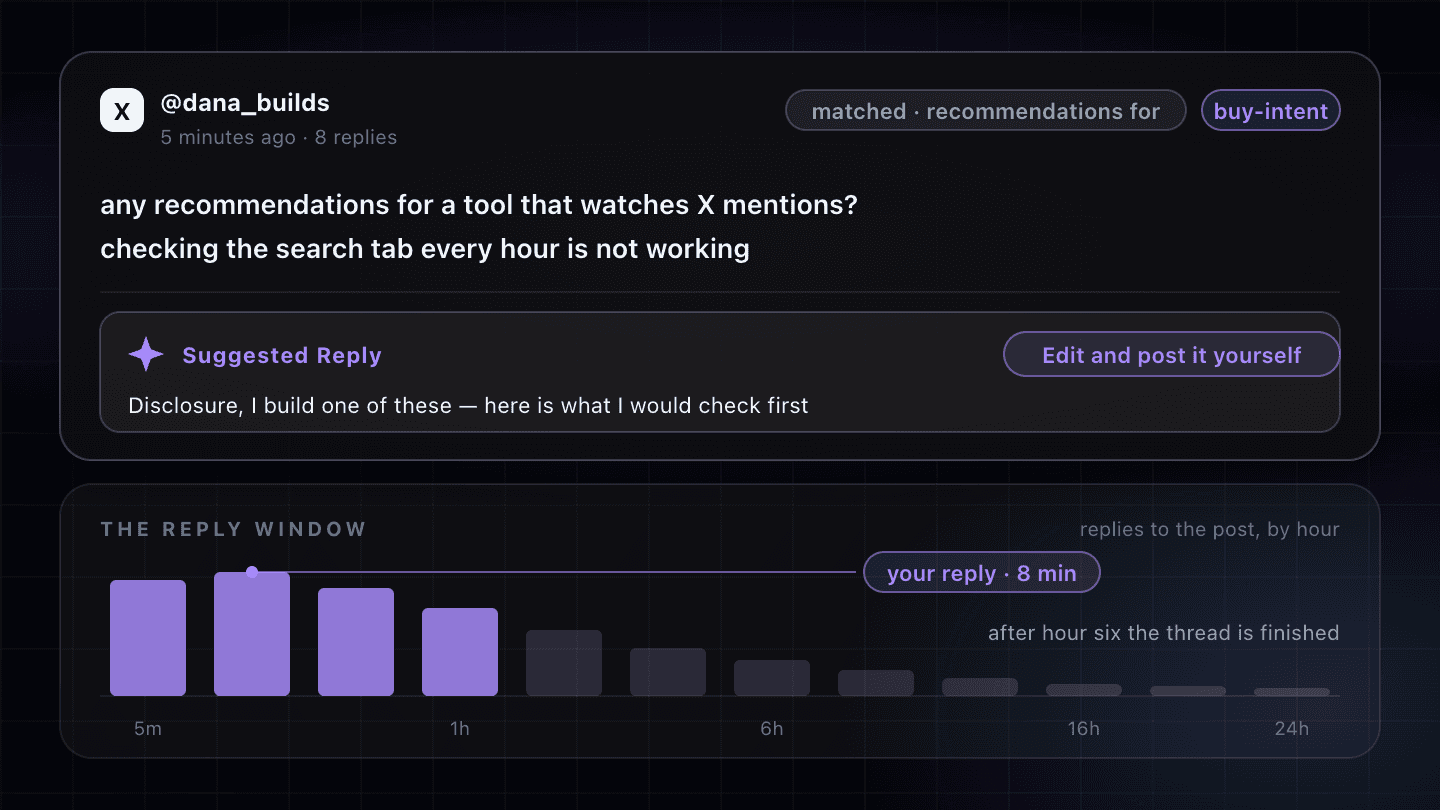
An X post from @dana_builds, five minutes old, asking “any recommendations for a tool that watches X mentions? checking the search tab every hour is not working” — matched to the keyword “recommendations for” and tagged buy-intent — with a Suggested Reply draft under it opening “Disclosure, I build one of these — here is what I would check first” beside a button reading “Edit and post it yourself”. Below the card, a chart labelled “the reply window” plots replies to that post by hour: violet through the first hour, pinned “your reply · 8 min” at the peak, then falling away to almost nothing under the note “after hour six the thread is finished”.
The short answer

How do you find leads on X (Twitter)?

You find leads on X by monitoring the phrases people type when they are asking for a recommendation — “looking for a tool”, “any alternative to”, “recommendations for” — and replying publicly while the post is still moving. ParseStream watches those phrases on X alongside Reddit, LinkedIn, Quora and Hacker News, qualifies each mention with AI Filter and Lead Detection, and tags what the person actually wants.

X rewards speed rather than depth. A post asking for suggestions collects its useful replies within hours and is effectively finished by the next day, so the job is to be in the thread early with an answer that stands on its own: no link dump, no unsolicited DM, and a plain disclosure that you build the thing you are recommending.

83%

of B2B decision-makers complete their research via peer communities and self-directed search before ever engaging a sales team — which on X means asking their timeline.

Source: SurveyMonkey with Reddit
2 in 3

buyers now prefer to talk to a vendor's salespeople only in the later stages, up 17 percentage points in a year — so the public reply reaches them long before any form does.

Source: G2 (2025 Buyer Behavior Report)
60%

of US B2B marketers plan to invest more in social media in 2025, a growing share of it aimed at listening rather than posting.

Source: Hootsuite (citing eMarketer)
01

Why is X a lead-generation channel and not just a feed?

X is where people think out loud before they have a plan. Somebody whose current tool just broke says so within about a minute, in public, with no intention of being marketed to — an unguarded sentence that is a better buying signal than anything they would write in a vendor form three weeks later.

That is the opportunity and the difficulty at once. The signal is real, but it is buried in a feed nobody can watch by hand, and it stops being actionable long before most teams notice it existed.

Buying questions get asked in the open

Software buying now happens almost entirely before anyone contacts a vendor. SurveyMonkey's study with Reddit, among 1,202 US business decision-makers, found 83% complete their research via peer communities and self-directed search before ever engaging with a sales team. G2's 2025 Buyer Behavior Report puts the same shift in terms of timing: nearly two out of three buyers now prefer to talk to a vendor's salespeople only in the later stages, up 17 percentage points in a year.

On X that research has a particular shape. Rather than searching, people ask their own timeline — “what is everyone using for this now?” — because they trust an answer more when it comes from someone they follow. The post is short, it names the problem in their own words, and it is addressed to nobody in particular. Anyone can answer it, including you.

A public reply is worth more than a DM

The instinct is to message the person privately, and it is wrong twice over: a DM to a stranger is unwelcome, and it is invisible to the twenty other people reading the same thread with the same problem. A reply is the opposite on both counts — read by everyone who opens the post, quoted and bookmarked by people who are not ready to buy yet, and attached to the conversation permanently.

Two mechanics are worth knowing. Authors can restrict who may reply, so occasionally the reply box is not available to you — a quote post carrying the same answer is the honest workaround. And replies are themselves searchable, which is why monitoring only top-level posts misses a whole layer of the conversations worth joining.

Where X is the wrong channel

Worth being straight about, because it decides whether any of this deserves your week. X is a poor fit if your buyers are not on it — plenty of categories do all their public thinking on LinkedIn or in one subreddit instead, and no amount of monitoring conjures posts that were never written.

It is also a poor fit if you cannot act inside the day: this channel converts on presence rather than thoroughness, and a team that batches its replies to Friday afternoon will get nothing from it. Expect volume, too — a short post containing your category term is very often somebody's joke about it, which is why qualification matters more here than anywhere else.

02

Which phrases on X actually signal buying intent?

Your brand name is the keyword everybody starts with and the one that finds the fewest leads, because the people worth reaching have not heard of you yet. What they type instead is remarkably consistent — a handful of sentence openings that people reach for when they want a peer to make a decision for them.

Each family below catches a different moment. Two or three entries from each is a complete starting list; a list of fifty is a list nobody reads twice.

The phrase families worth monitoring on X, with what they sound like in a real post.
Phrase familyWhat it looks like on XWhy it converts
Asking for a tool“looking for a tool that…”, “any tool for…”, “is there anything that…”The shortest window and the highest intent on the platform. They are choosing today, and the replies they get are the shortlist.
Alternative-seeking“any alternative to <rival>”, “alternatives to <rival>”, “moving off <rival>”The category research is already done. All that is left is picking a replacement, and they have told you what they are replacing.
Recommendation requests“recommendations for…”, “what does everyone use for…”, “who has a good…”Addressed to the timeline rather than to a search engine, so a useful stranger is welcome. Answer it like a person, not like a vendor.
Frustration and churn“just cancelled…”, “<rival> pricing change”, “done with <rival>”Not a request for help, so tread carefully — but it is the earliest possible warning that someone is about to go looking.
Product questions“does anyone know if <tool> can…”, “can <tool> do…”Someone is evaluating out loud. If the answer is yes and it is your product, say so and disclose it; if the answer is no, say that too.
Problem phrases“doing this by hand every week”, “tired of copying this into a spreadsheet”The least contested family. Nobody here knows the category has a name, so no competitor is watching for these.
The phrase families worth monitoring on X, with what they sound like in a real post. Your own brand name still belongs on the list — just never on its own, and never only the correct spelling. Matching is case-insensitive, so capitalisation costs you nothing; the misspelling people type from memory does.

Keep X keywords short, because X posts are short

X carries the shortest text of any platform worth monitoring, and a long keyword rarely appears verbatim inside three lines. “Looking for a tool to monitor brand mentions across social platforms” is a sentence nobody has ever posted; “looking for a tool” is one people post constantly. The practical ceiling is three or four words, and anything longer belongs as a shorter keyword with an AI Filter attached.

One trap is specific to this platform: keep X's own search syntax out of your keywords. ParseStream builds the X query around what you typed, so a leading minus, a “from:” prefix or a “filter:” term is interpreted by X's search rather than treated as text — a keyword meant to exclude something will quietly change what X returns instead.

03

Why does speed matter more on X than anywhere else?

Because the post is gone. Not deleted — buried, which is functionally the same thing. A question posted to a timeline collects its replies while it is still circulating, and once it stops circulating it stops being read, whether or not it was ever answered well.

That inverts the advice that works everywhere else. On Reddit and Quora the best answer wins eventually, because the thread keeps being found through search for years. On X there is no eventually: the first genuinely useful reply is the one the poster reads, thanks and acts on, and the eleventh arrives after the decision.

What the first useful reply actually wins

Three things, in ascending order of value. It is read by the person who asked, at the point where they are more receptive than they will be again. It is read by everyone else in the thread, usually a larger and more interesting group. And it sits near the top of the replies for the life of the post, so anyone arriving later reads it first.

None of that is available to the reply posted tomorrow. It is not that a late reply is penalised; it is that nobody scrolls back.

What “fast” means mechanically

Worth being precise rather than aspirational, because any vendor promising real-time anything is rounding. ParseStream re-checks each keyword about once an hour, and its X query covers the last hour of posts and replies, so a matching post reaches you inside that window — comfortably early on a post that stays live for most of a day, and no use if you were hoping to be the very first reply.

That is the right target anyway. Being early and useful beats being first: a considered reply at hour one outperforms a reflexive one at minute three.

One consequence to plan around is that X keywords have no history. Reddit and Hacker News hand a new keyword a week of past posts to judge the phrase by; X starts from the moment you add it. Put your X keywords in before you need them, and give a new phrase a few days before deciding it was a bad one.

04

How do you reply on X without reading as spam?

The reply is the entire product here. Monitoring only buys you the chance to write it, and a bad one costs more on X than elsewhere, because a reply that reads as marketing gets quote-posted by strangers as an example of marketing.

The format works against you too. There is no room to warm up — by the time you have written a friendly opening line you have spent the only two lines anyone will read — so the answer has to be the first clause and everything else is optional.

A useful test before posting: delete every mention of your company from the draft. If what is left still answers the question, it is worth posting. If it collapses into nothing, you have written an advertisement, and it will be read as one.

  • Lead with the answer. Not “great question”, not “we built this for exactly that” — the answer, in the first clause, in plain language.
  • Disclose in the same post, not in a follow-up. “Biased, I build one of these” costs six words and turns a suspicious reader into a neutral one.
  • Do not link-dump. A bare URL as the whole reply is the fastest way to get reported. Say the useful thing first and offer the link only if someone asks.
  • Give one concrete detail — a limit, a number, a thing that does not work. Specifics are the only credible signal available in two lines.
  • Recommend a competitor when it genuinely fits better. On a platform where everyone is selling, the person who occasionally does not is the one people remember.
  • Never quote-post to argue with a complaint about a rival. Piling on is visible to everyone and reflects on you, not on them.
  • Do not follow up in DMs uninvited. If they want to keep talking they will reply, and the public conversation was worth more anyway.
05

How do you build a keyword list for X specifically?

The same five families that work everywhere else, translated for a platform where posts are three lines long, there is no community scoping, and the meter runs before anything gets filtered. Five steps, in the order they are worth doing.

  1. Step 1Write the phrases down from real posts, not from memory

    Spend twenty minutes in X's search reading actual posts in your category and copy the sentence openings people really use. They will not be the ones you would have invented: every category has its own shorthand, and the phrase your buyers type is almost never the phrase on your pricing page.

    • Two or three ask-phrases: “looking for a tool”, “any tool for”, “recommendations for”.
    • Your two or three real competitors, plus “alternative to <rival>” and “moving off <rival>”.
    • Two problem phrases in the customer's words, not your product's.
    • Your brand, the spaced-out version, and the misspelling people type from memory.
  2. Step 2Decide what each keyword should match, and how

    Broad Match is the default: every word has to appear somewhere in the text, in any order and any distance apart. On a platform where a whole post is thirty words long that is far less dangerous than it sounds — there is no room for two words to drift apart meaninglessly.

    Phrase Match, the per-keyword toggle beside it, requires the exact phrase in order and is literal about spacing and punctuation. Use it where word order carries the meaning: brand names, product names, “alternative to <rival>”. It is a local re-check, not something sent to X's search.

  3. Step 3Choose posts, replies, or both

    Each keyword can watch top-level posts, replies, or both, and the choice changes what you see. Ask-phrases belong on both, because plenty of the best questions on X are asked as a reply inside somebody else's thread. Competitor names are often better as posts only — replies naming a rival are frequently just a conversation about them, and the volume is high. It is a per-keyword setting, which is what lets an expensive broad term stay narrow while a precise phrase stays open.

  4. Step 4Prove a phrase somewhere cheap before promoting it to X

    X and LinkedIn meter differently from the rest. X consumes 0.5 credits per item retrieved and LinkedIn 1 per post, charged before anything filters them; Reddit, Hacker News and Quora only start costing once a mention has already matched a keyword and reaches the AI-check stage.

    So do the loose, exploratory phrasing on Reddit and Hacker News where mistakes are cheap, then move the phrases that produced real conversations onto X. It is also why X keywords sit on Pro and Growth rather than the entry plan — 10 on Pro, 25 on Growth.

  5. Step 5Read a week, then cut something

    Sort a week of X mentions into three piles: worth replying to, real but not for you, and noise. The ratio per keyword is the diagnostic, and the answer is almost never to add more keywords — a phrase that produced four mentions of which three were worth answering is your best keyword even though it is your quietest.

    Keep the list near fifteen entries and retire one each time you promote a phrasing you learned from a real thread. Lists that only grow drift back into the flood they started as.

06

How does ParseStream automate the monitoring?

Everything above works without any tool at all, and for the first week you should probably do it by hand — twenty minutes a day in X search will teach you more about your buyers' vocabulary than any dashboard. What it will not do is survive a normal month. Nobody keeps six saved searches open for a quarter.

The automation is not a different process. It is the same process running continuously, with the reading-and-discarding part done before the queue reaches you.

One keyword list, monitored across five platforms

Each keyword can be pointed at X, Reddit, LinkedIn, Quora and Hacker News independently, so a phrase can run where it is cheap to test and then move to X once it has proved itself. New matches arrive by email, in Slack, or both, inside the hour they were posted.

AI Filter and Lead Detection do the qualifying

Raw keyword matching is blunt, and on X it is bluntest of all. Two layers fix that. An AI Filter is your own rule, written in plain English and attached to a keyword — “only keep posts where someone is asking for a tool recommendation”. Lead Detection then judges each mention against your brand context and marks the ones that are genuine lead opportunities.

The list gets much smaller and much denser. It also means you can loosen the keyword underneath, which widens what you catch and narrows what you read at the same time.

Intent Detection tells you which mention to open first

Whenever Lead Detection or an AI Filter is running on a keyword, each mention also gets a single intent tag at no extra cost — buy intent, product question, competitor complaint, pain point, testimonial or promotional. The Leads view collects the qualified lead opportunities with those tags visible.

On X that triage is the whole game. Buy intent and product question have a clock on them; pain point can wait until the afternoon and will still be there.

Suggested Replies are drafts — you post them yourself

ParseStream drafts a Suggested Reply from your brand context and the post it appeared in. Treat it as a first draft: cut it to two lines, put the answer in the first clause, add the detail only someone who built the thing would know, and keep the disclosure.

ParseStream does not post for you, on X or anywhere else. Automatic posting is disabled at the server level by design rather than for want of building it — an unedited AI reply is recognisable, and on a platform this public it is the fastest way to become an example.

Frequently Asked Questions

How is this different from just using X search myself?

Which parts of X does ParseStream monitor?

How quickly will I hear about a new X mention?

How many X keywords does each ParseStream plan include?

Why do X mentions cost credits differently?

Does ParseStream post replies to X for me?

Be in the thread while it is still moving

Add the phrases your buyers type when they are asking for a recommendation. ParseStream watches X for them alongside Reddit, LinkedIn, Quora and Hacker News, qualifies the lead opportunities, tags what each person wants, and drafts a reply for you to edit and post yourself.

3-day free trial · X keywords on Pro and Growth · You post every reply yourself